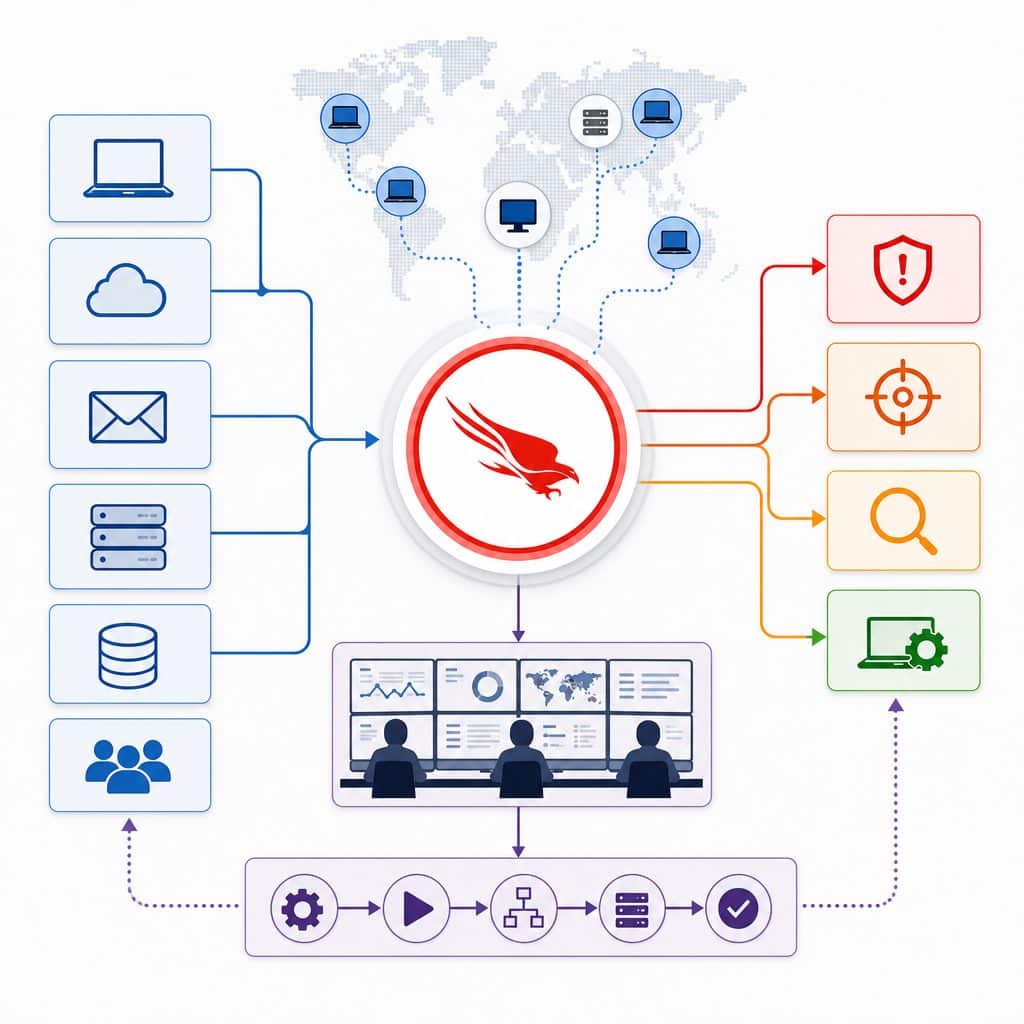
CrowdStrike Falcon is a strong endpoint and cloud security platform, but buying the technology is not the same as operating it well. Security teams still need tuned policies, 24/7 alert review, investigation discipline, containment decisions, reporting, and continuous improvement. CrowdStrike monitoring services close that gap by pairing Falcon telemetry with experienced analysts who know how attackers behave, how business systems operate, and when an alert deserves action.
For many organizations, the problem is not a lack of tools. It is the operational drag created by too many consoles, noisy detections, incomplete asset context, and limited staff capacity. A managed provider such as Clearnetwork helps organizations run CrowdStrike as part of a broader security program, not as an isolated endpoint product.
The threat environment rewards speed. CrowdStrike’s 2024 Global Threat Report reported that the average eCrime breakout time fell to 62 minutes, with the fastest observed breakout measured in minutes. Verizon’s 2024 Data Breach Investigations Report again showed credential abuse and human driven attacks as dominant patterns. IBM’s 2024 Cost of a Data Breach Report put the global average breach cost at 4.88 million dollars. These numbers matter because endpoint alerts often represent the first practical opportunity to interrupt an intrusion before it becomes ransomware, data theft, or business disruption.
The challenge is that Falcon can generate high fidelity signals only when the deployment is healthy, sensors are current, policies match the environment, and analysts understand the normal behavior of users and systems. Monitoring is therefore both a technology service and an operations service.
A credible service goes beyond forwarding alerts to an inbox. It should define ownership, response authority, escalation paths, use case coverage, and measurable outcomes. Clearnetwork’s approach to managed CrowdStrike monitoring focuses on the daily work that determines whether Falcon produces reliable security value.
Analysts verify deployment coverage, sensor status, version drift, and policy assignment so unmanaged endpoints do not become blind spots.
Events are reviewed for severity, asset criticality, user context, and likely attacker intent before they are escalated to internal teams.
False positives, prevention policy changes, exclusions, and exception requests are handled with change discipline, documentation, and periodic review.
When activity looks malicious, Clearnetwork helps scope affected hosts, preserve evidence, recommend containment, and coordinate response with stakeholders.
For organizations evaluating CrowdStrike management, Clearnetwork offers Managed CrowdStrike support that connects endpoint monitoring with escalation, tuning, and operational guidance. That connection is essential because endpoint decisions rarely happen in isolation; they affect identity, network, cloud, legal, and business continuity teams.
Clearnetwork positions Falcon within a managed security operating model. The service is designed for organizations that need more than product administration but are not trying to outsource every security decision. The goal is to give internal teams confidence that critical endpoint telemetry is being watched, investigated, and translated into action.
Day to day operations typically include onboarding reviews, role and permission checks, prevention policy tuning, custom indicator handling, alert queues, incident notes, customer notification, and service reporting. Clearnetwork can also coordinate CrowdStrike signals with other controls, including firewalls, identity platforms, vulnerability data, email security, and SIEM monitoring when those sources are available.
This matters in real investigations. A Falcon detection may show suspicious PowerShell execution, but the right response depends on user identity, exposure, command line details, authentication history, and whether the host contains regulated data. Monitoring analysts bring those pieces together so the customer receives a decision, not just an event.
Buyers often compare several service categories. The labels overlap, but the operating scope is different. CrowdStrike monitoring usually centers on Falcon administration and alert handling. Managed Detection and Response adds active investigation and response workflows across high risk detections. Managed SOC Services broaden the function further, combining monitoring across tools, processes, and reporting. SOC as a Service can provide the outsourced operating model for organizations that need continuous security operations without building a full internal SOC.
| Service model | Primary value | Best fit |
|---|---|---|
| CrowdStrike monitoring | Falcon health, alert triage, tuning, and escalation | Teams with Falcon deployed but limited endpoint operations capacity |
| MDR services | Threat investigation, response recommendations, and containment support | Organizations needing stronger detection and response outcomes |
| Managed SOC Services | 24/7 monitoring, correlation, reporting, and operational governance | Teams that need broader security operations across multiple tools |
| SOC as a Service | Outsourced SOC processes, analysts, and escalation coverage | Organizations choosing a managed operating model instead of building internally |
The right answer is not always the largest service. Some companies need expert CrowdStrike alert triage first; others need a 24/7 managed SOC that incorporates Falcon, SIEM, identity, and network telemetry. Clearnetwork helps define the practical scope before teams commit budget or sign a long term contract.
Procurement teams often ask whether a provider can monitor Falcon. Security leaders should ask more specific questions that reveal operational maturity:
The answers affect risk and workload. A low cost monitoring service that simply passes every medium or high alert to your team may create more work than it removes. A mature service should reduce noise, preserve accountability, and escalate with enough context for business owners to make fast decisions.
CrowdStrike tuning is not a one time configuration exercise. New software, scripts, administrators, remote work patterns, mergers, and cloud workloads continually change the environment. Without disciplined tuning, a team can end up with either excessive noise or risky exclusions that suppress meaningful detections.
Clearnetwork analysts look for patterns: repeated benign detections from approved tools, suspicious behaviors occurring on high value assets, and endpoint groups with inconsistent prevention policy. The outcome should be fewer unnecessary interruptions and faster action when activity is genuinely dangerous.
Monitoring services should clarify what happens after validation. Some providers only notify. Others can help isolate endpoints, collect details, guide eradication, and support internal incident response teams. The best model depends on risk tolerance, regulatory obligations, cyber insurance requirements, and internal authority.
A practical escalation should include the affected endpoint, user, detection logic, observed commands or files, severity rationale, recommended action, and current containment state. If the event touches privileged accounts or regulated data, the escalation path should be faster and more formal.
Clearnetwork’s managed threat detection and response experience helps customers avoid two common failures: waiting too long to contain a host, and containing too aggressively without understanding business impact. The service objective is balanced action, documented decisions, and rapid communication.
Endpoint telemetry becomes more useful when it is connected to other evidence. A Falcon alert on a developer workstation means something different when the same user just authenticated from an unusual location, accessed a sensitive repository, or appeared in a recent phishing campaign.
Clearnetwork can support correlation through SIEM monitoring, ticketing workflows, and customer defined notification channels. Where organizations use the AlienVault platform or another SIEM, the objective is not to duplicate Falcon alerts; it is to enrich them, confirm patterns, and support compliance reporting.
Vulnerability and asset data also improve prioritization. A suspicious process on an internet facing server with exploitable software deserves different urgency than the same detection on a low risk test machine. Good monitoring services make those distinctions visible.
CrowdStrike monitoring decisions involve tradeoffs. The right provider should discuss them openly instead of promising effortless security.
| Pitfall | Operational impact | Better approach |
|---|---|---|
| Alert forwarding without investigation | Internal teams still carry the cognitive load and may miss urgent context | Require validation, severity rationale, and recommended next steps |
| Overbroad exclusions | Noise falls, but real attacker behavior may be suppressed | Use documented exception reviews and compensating controls |
| Unclear response authority | Analysts hesitate while attackers move laterally | Predefine isolation, notification, and approval rules by severity |
| Tool only reporting | Executives see activity counts instead of risk reduction | Report coverage, response time, tuning actions, and business risks |
The best buyer conversations cover what will not be included. For example, digital forensics, legal notification, malware reverse engineering, and full disaster recovery may require separate retainers or incident response partners. Clear boundaries prevent disappointment during a crisis.
Useful metrics should be tied to risk reduction and operational performance, not vanity counts. Alert volume can rise because detection improved, because tuning degraded, or because the business changed. Context matters.
Clearnetwork uses reporting to guide decisions, not to flood stakeholders with charts. A security leader should be able to see which risks are improving, which controls need attention, and which business units require follow up.
Clearnetwork is a strong fit when an organization has invested in Falcon but lacks the time, staffing model, or specialized experience to operate it continuously. That situation is common in mid market companies, lean enterprise teams, regulated businesses, and organizations integrating security after acquisitions.
It is also useful when internal analysts are overwhelmed by endpoint alerts, when executives need clearer incident accountability, or when compliance programs require evidence that security events are monitored and handled consistently. Clearnetwork can provide targeted CrowdStrike support or connect the endpoint function into broader outsourced security operations.
Not every customer needs the same service depth. Some start with health checks and alert triage. Others need 24/7 detection and response, SIEM correlation, and recurring executive reporting. The engagement should match business risk, not a generic package.
A phased rollout reduces disruption and creates measurable progress. Clearnetwork typically aligns monitoring around these steps:
This roadmap keeps the service practical. It avoids the common mistake of turning on every capability at once, overwhelming analysts, and creating business friction before governance is ready.
Not always. Monitoring may focus on Falcon health and alert triage, while MDR usually includes broader investigation and response workflows. Many organizations need both capabilities aligned under one operating model.
Yes. Clearnetwork commonly augments internal teams by handling monitoring, tuning, investigation support, escalation, and reporting while leaving business ownership and final authority with the customer.
Early value often comes from coverage cleanup, noisy detection reduction, and clearer escalation rules. Deeper value builds as analysts learn the environment and integrate additional telemetry.
If Falcon is strategic to your security program, make sure it is operated with the same discipline you expect from any critical control. Clearnetwork can help validate gaps and define the right service model today.
Cut EDR alert fatigue without creating blind spots. Learn to prioritize high-risk signals, automate enrichment,…
Secure third-party remote access with MFA, accountable owners and complete visibility—critical as vendors feature in…
Turn PCI DSS 4.0.1 monitoring into faster payment threat response—master Requirements 10, 11 and 12,…
Protect plant uptime with passive OT security monitoring. Map legacy assets, baseline traffic, and detect…
Contain a Microsoft 365 BEC in 24 hours: revoke sessions, preserve evidence, stop payment fraud,…
Make SIEM costs predictable with a 4-layer TCO model covering licensing, data ingestion, security operations…