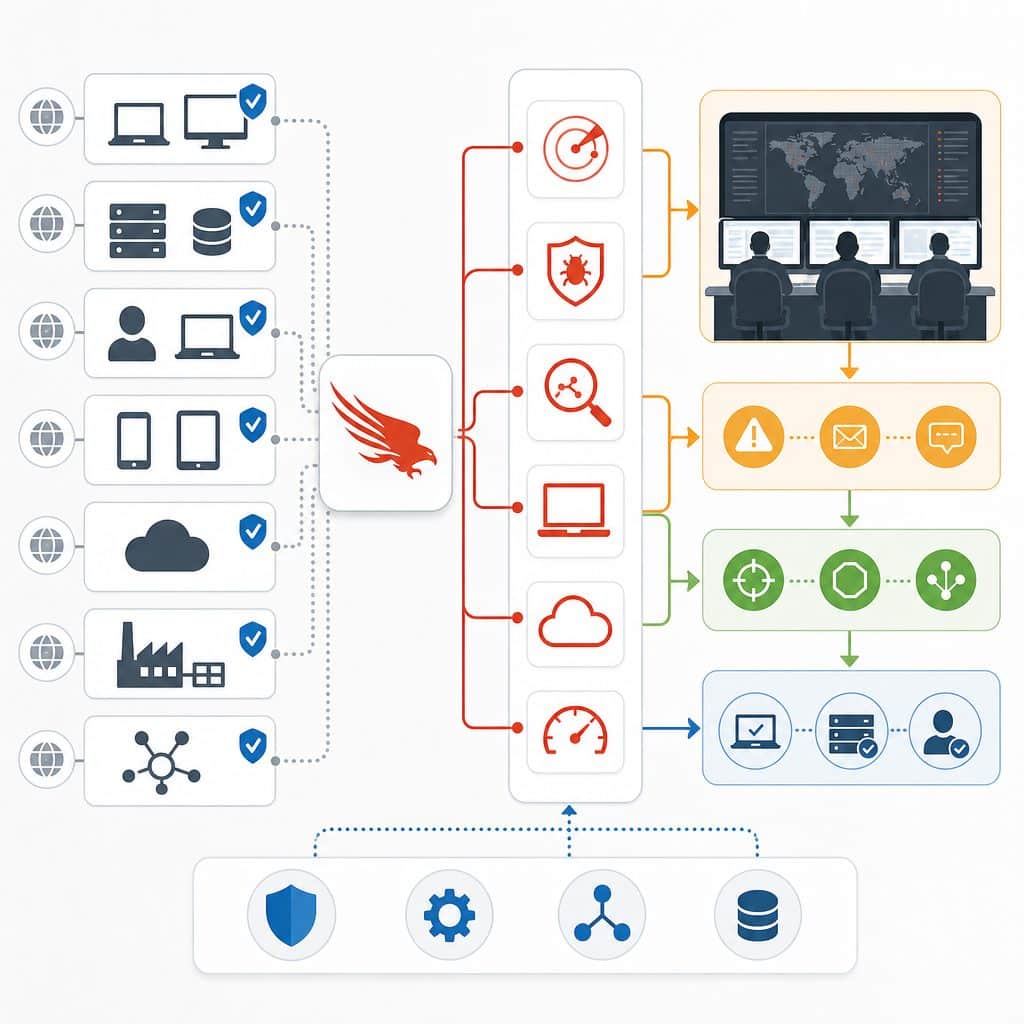
CrowdStrike Falcon is widely adopted because it gives security teams strong endpoint visibility, cloud-delivered prevention, behavioral detection, and rapid containment options. Yet buying Falcon sensors is not the same as running an effective endpoint detection and response program. Most organizations still need disciplined policy design, alert triage, investigation, threat hunting, escalation, reporting, and response coordination every day.
Managed CrowdStrike EDR closes that operational gap. It combines Falcon technology with experienced analysts and repeatable processes that make endpoint telemetry actionable. For lean IT and security teams, the goal is not more dashboards; it is faster decisions, fewer missed signals, and a cleaner path from suspicious behavior to verified response.
Clearnetwork helps organizations operate, monitor, tune, investigate, and respond across cybersecurity technologies and programs. With managed CrowdStrike support, clients keep the value of Falcon while gaining the workflow, coverage, and accountability of an experienced managed security services provider.
Endpoint compromise remains one of the fastest ways attackers reach identity stores, cloud consoles, business applications, and backups. Verizon’s 2024 Data Breach Investigations Report highlights credential abuse and exploitation of vulnerabilities as persistent breach patterns. IBM’s 2024 Cost of a Data Breach Report puts the global average breach cost at 4.88 million dollars. CrowdStrike’s Global Threat Report continues to show faster hands-on-keyboard intrusions and heavy use of identity-based techniques.
Those trends change the endpoint conversation. Boards ask whether the organization can detect ransomware staging before encryption, prove which assets were touched, and recover without guesswork. Security leaders ask whether existing tools are producing trusted outcomes or merely another queue of unworked alerts.
A mature service should cover the full lifecycle, not only after-hours alert forwarding. Clearnetwork’s approach is built around practical security operations: establish the right configuration, monitor relevant detections, investigate with context, recommend or execute response actions, and improve the environment over time.
Sensor deployment, grouping, prevention policies, exclusions, and role design are reviewed so coverage reflects business risk instead of default assumptions.
Analysts watch detections, severity changes, host context, and escalation criteria so critical events are not dependent on local business hours.
Events are correlated with identity, asset, vulnerability, and network context where available, reducing false positives and improving response confidence.
When activity is credible, Clearnetwork helps decide whether to isolate hosts, kill processes, collect evidence, or coordinate incident response.
Detections, exclusions, workflows, and severity thresholds are adjusted carefully, preserving security coverage while reducing fatigue for internal teams.
Regular reviews translate endpoint activity into operational decisions, open risks, response metrics, and roadmap priorities for leadership.
This operating model also connects endpoint work with broader programs. Teams using Managed Detection and Response can align CrowdStrike investigations with network, cloud, and identity signals instead of treating endpoint telemetry as an isolated silo.
Many CrowdStrike customers start with strong prevention but uneven operations. The technology is capable; the question is whether the organization has enough trained people, documented procedures, and response authority to use it well when an alert arrives at 2:00 a.m.
| Problem | Operational impact | Managed EDR answer |
|---|---|---|
| Alert overload | Analysts miss meaningful patterns when queues contain benign software behavior, duplicate detections, and low priority noise | Tune policies, apply context, document exceptions, and escalate verified activity |
| Unclear ownership | Security, IT, legal, and operations may disagree on who can isolate systems or approve disruptive actions | Define escalation paths, decision rights, and communications before incidents |
| Coverage gaps | Unmanaged endpoints, stale sensors, and poor grouping reduce visibility where attackers often move first | Review deployment health, policy inheritance, and high-risk asset coverage |
| Slow investigations | Teams lose time collecting host details, user context, hashes, and process chains | Enrich alerts and preserve evidence for faster triage and response |
These issues are not signs that Falcon failed. They are signs that endpoint security has become an operational discipline. A managed provider should make that discipline visible, measurable, and repeatable.
Clearnetwork’s role is to make Falcon useful inside the client’s real environment, with its constraints, change windows, compliance needs, and staffing model. Engagements typically include operational onboarding, notification rules, incident severity definitions, and an agreed response playbook.
Key activities include:
Organizations that need broader alert triage, SIEM correlation, and 24/7 managed security monitoring often combine CrowdStrike support with Managed SOC Services. That broader model helps connect endpoint events to firewall, identity, email, cloud, and vulnerability data.
Buyers often compare managed CrowdStrike, MDR, SOC outsourcing, and internal staffing as if they were identical. They overlap, but they solve different problems. The right choice depends on existing tools, regulatory requirements, appetite for co-management, and how quickly the organization must improve coverage.
| Option | Best fit | Tradeoff |
|---|---|---|
| Internal Falcon administration | Organizations with mature security engineering, 24/7 analysts, and incident response capacity | High staffing cost, difficult retention, and slower maturity for lean teams |
| Managed CrowdStrike EDR | Teams that own Falcon licenses but need expert operation, monitoring, tuning, and response support | Scope should be aligned with escalation authority and adjacent telemetry |
| MDR services | Organizations seeking active threat detection and response across endpoints and additional control points | Requires clear integration expectations and response playbooks |
| SOC as a Service | Companies needing broader 24/7 alert triage, SIEM monitoring, reporting, and compliance support | May involve more platforms and governance than endpoint-only support |
For some clients, SOC as a Service is the right construct because endpoint alerts are only one part of the risk picture. For others, focused Managed CrowdStrike support is enough to turn an underused Falcon investment into a dependable control.
A high-quality managed EDR service does not simply repackage vendor alerts. Analysts should reconstruct what happened, why it matters, and what the client should do next. That means reviewing process ancestry, command-line arguments, file writes, persistence attempts, network destinations, user activity, and related hosts.
The output should be concise and decision-ready: affected asset, user, detection reason, confidence level, observed behavior, likely tactic, recommended containment, and evidence retention steps. Mapping activity to MITRE ATT&CK can help explain adversary behavior consistently, especially when leadership or auditors need a defensible narrative.
Clearnetwork emphasizes escalation quality because response fatigue is real. If every alert is treated as urgent, business teams stop trusting security notifications. If escalations are too conservative, attackers gain dwell time. Mature managed EDR balances speed with evidence.
Tuning is often misunderstood. The objective is not to silence the console; it is to remove known benign activity while preserving detection depth. Poorly governed exclusions can create gaps that attackers later abuse, especially on developer workstations, administration tools, and high-value servers.
Good tuning uses evidence. Analysts verify the process, signer, parent-child relationship, file path, prevalence, business owner, and compensating controls before suppressing repeated detections. Changes should be documented, periodically reviewed, and tied to policy groups rather than broad global exceptions whenever possible.
Useful tuning questions include:
This discipline is where managed operations produce measurable value. Better tuning improves analyst focus, reduces unnecessary business disruption, and protects the credibility of the endpoint program.
Endpoint response can be disruptive. Isolating a server, blocking a tool, or collecting forensic data may affect operations, legal preservation, customer commitments, or regulatory notifications. Managed CrowdStrike EDR works best when the response model is agreed before a crisis.
Clearnetwork helps define practical playbooks: when analysts notify only, when they recommend action, when they can request approval, and when emergency containment is authorized. The playbook should include contacts, backups, after-hours procedures, business criticality rules, and evidence handling requirements.
This governance matters because attackers move quickly. The Cybersecurity and Infrastructure Security Agency regularly warns that rapid containment and credential resets are essential during ransomware and intrusion response. Delayed decisions can turn a single compromised endpoint into a broader outage.
Security leaders should require reporting that explains service performance and risk movement, not vanity charts. Endpoint metrics should help answer whether the environment is better protected this month than last month.
| Metric | Why it matters |
|---|---|
| Sensor coverage | Shows whether critical assets are reporting and protected |
| Detection volume by severity | Reveals noise, tuning needs, and risk concentration |
| Mean time to triage | Measures how quickly alerts receive human review |
| Mean time to escalate | Shows whether credible threats reach decision makers fast |
| Containment outcomes | Confirms which actions were taken and why |
| Top recurring detections | Guides policy changes, software fixes, and awareness work |
The best service reviews are candid. They acknowledge gaps, document decisions, and identify actions for both Clearnetwork and the client. That is how managed EDR becomes a continuous improvement program rather than a monthly ticket summary.
Selecting a provider should be more rigorous than confirming certification badges. Buyers should validate operational fit, communication quality, and accountability for outcomes.
Important criteria include:
If you are evaluating whether Falcon is delivering the outcomes expected, talk to Clearnetwork about managed security support. A focused assessment can uncover coverage gaps, noisy detections, unclear escalation rules, and opportunities to improve response speed.
No. Managed CrowdStrike EDR focuses on operating and monitoring Falcon endpoint capabilities. MDR is usually broader, combining endpoint, identity, cloud, network, or SIEM signals with active detection and response.
You still need business owners who can approve changes, provide context, and coordinate remediation. Clearnetwork supplies security operations expertise, investigation capacity, and response guidance that many internal teams cannot staff continuously.
Yes, when paired with strong prevention, identity controls, patching, backups, and rehearsed response. Managed EDR can identify suspicious staging, lateral movement, credential theft, and encryption precursors earlier.
That is common. CrowdStrike investigations should complement SIEM workflows by providing endpoint detail, while SIEM monitoring adds identity, network, cloud, and application context for broader correlation.
Falcon is powerful, but outcomes depend on disciplined operations. Clearnetwork helps organizations monitor, tune, investigate, and respond with the consistency required for real risk reduction. Whether you need targeted CrowdStrike management or broader outsourced security operations, the next step is a practical review of current coverage, escalation paths, alert quality, and response readiness with priorities your team can act on quickly and confidently.
Cut EDR alert fatigue without creating blind spots. Learn to prioritize high-risk signals, automate enrichment,…
Secure third-party remote access with MFA, accountable owners and complete visibility—critical as vendors feature in…
Turn PCI DSS 4.0.1 monitoring into faster payment threat response—master Requirements 10, 11 and 12,…
Protect plant uptime with passive OT security monitoring. Map legacy assets, baseline traffic, and detect…
Contain a Microsoft 365 BEC in 24 hours: revoke sessions, preserve evidence, stop payment fraud,…
Make SIEM costs predictable with a 4-layer TCO model covering licensing, data ingestion, security operations…