
In an era where cyber threats are no longer just human-led but machine-driven, the defensive perimeter has to work at a speed that traditional security models simply cannot match. For years, the Security Operations Center (SOC) was a place where analysts spent their shifts staring at a relentless flow of alerts, many of which were little more than digital background noise.
By the time 2026 arrived, this human-only triage became a liability. This shift is why best practices for modernizing SOC with artificial intelligence have moved from being a luxury to a baseline requirement for any organization serious about data integrity.
Modernizing a security posture is not about buying a new software license and checking a box. It is a strategic overhaul that changes how data is perceived, how decisions are made, and how human talent is valued.
The Core Philosophy: Human-Agent Teaming
The most significant change in the current security environment is the move away from the black box mentality. A modern, AI-enabled SOC is built on the principle of partnership. Why should a human spend four hours doing what a machine can do in four seconds?
Defining the AI Teammate
The best practices for modernizing SOC with artificial intelligence suggest that we should treat AI as an active teammate rather than a passive assistant. In the past, AI might summarize an alert; today, it plans and executes multi-step investigation sequences. It doesn’t just say an IP is suspicious. It queries the identity provider, checks for recent password resets, and reviews endpoint logs for signs of lateral movement before a human analyst even opens the ticket.
The Importance of Explainability
If a system makes a decision but cannot show its work, it becomes a liability. Among the best practices for modernizing SOC with artificial intelligence is the demand for Explainable AI (XAI). Every automated action or recommendation must be accompanied by a clear logic trail. This transparency is what allows a SOC manager to trust the machine’s judgment and gives auditors the evidence they need to verify compliance.
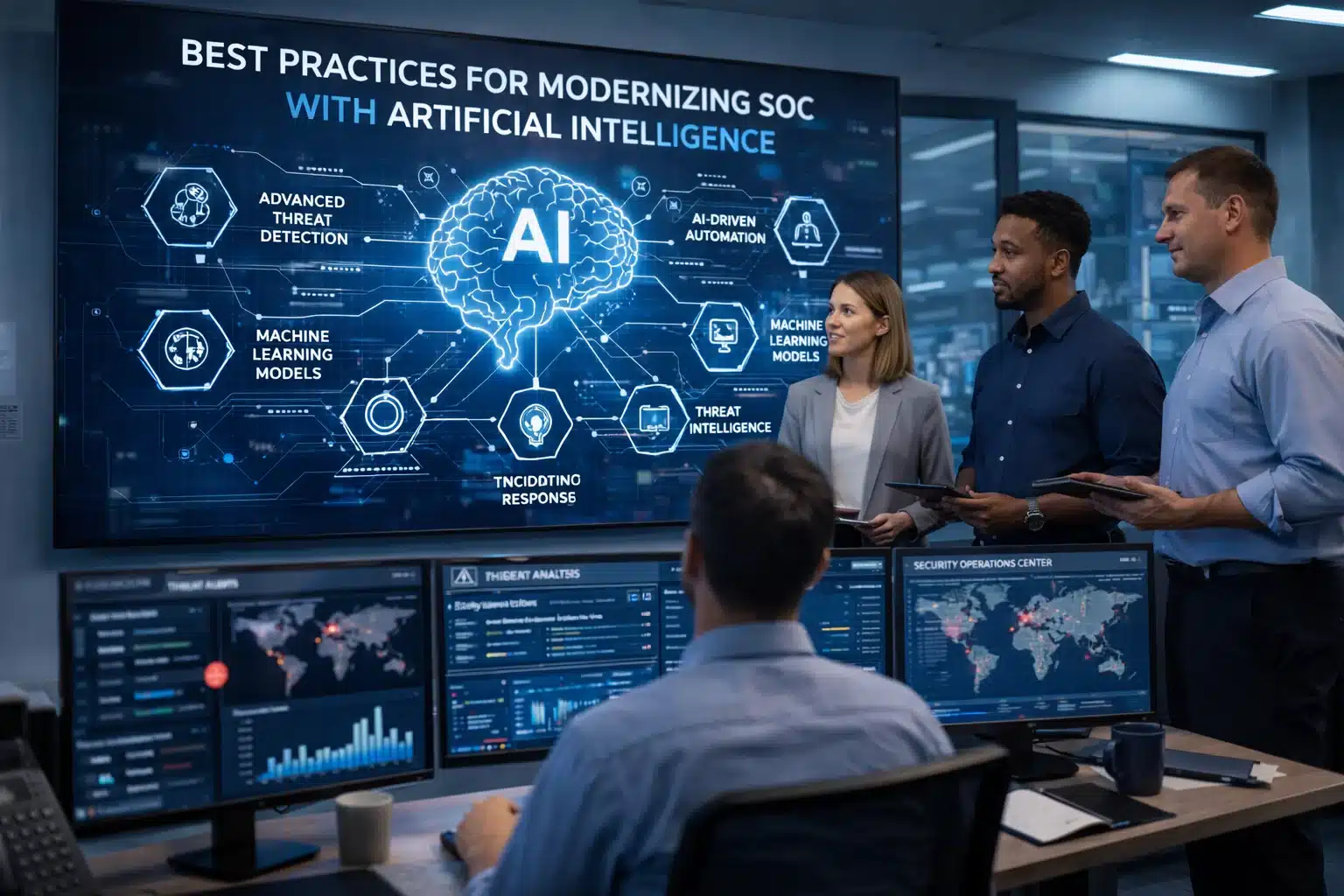
Best Practices for Modernizing SOC with Artificial Intelligence
To successfully transition into an intelligence-led defense, organizations should follow a structured approach that prioritizes trust, data quality, and operational speed.
1. Implement AI in Shadow Mode Initially
One of the most effective best practices for modernizing SOC with artificial intelligence is to start by running models in shadow mode. During this phase, the AI analyzes incoming alerts and generates verdicts in the background, but it does not take any autonomous actions.
By comparing these recommendations against the manual decisions made by senior analysts, a company can measure accuracy and establish a trust baseline. Once the system consistently achieves a high accuracy rate, it becomes safe to begin automating low-risk containment steps.
2. Prioritize Data Hygiene as Regulated Infrastructure
AI is only as good as the telemetry it consumes. In 2026, data hygiene is no longer just a technical task; it is a fundamental requirement. Best practices for building an AI-enabled SOC include treating training and operational data as critical infrastructure.
This means maintaining clear data lineage, ensuring that logs are normalized across all vendors, and using decentralized, domain-oriented architectures to prevent data silos. If the machine is fed dirty data, it will produce fast but wrong insights.
3. Leverage Agentic Workflows for Pre-Triage
The real bottleneck in most security centers is the pre-triage phase—the time spent gathering evidence. By following best practices for modernizing SOC with artificial intelligence, firms can deploy agentic workflows that act as digital private investigators.
These agents automatically gather context from cloud, endpoint, and network telemetry. They don’t just alert; they deliver a fully documented incident package to the analyst, cutting the Mean Time to Triage (MTTT) from hours to minutes.
4. Move to Policy-Aware Autonomous Response
Automation should not be reckless. The best practices for running an efficient SOC involve setting strict guardrails or thresholds for autonomous actions. For example, a system might be permitted to automatically isolate a guest laptop if ransomware is detected, but it should require human approval before shutting down a production database server.
This policy-aware approach allows the machine to act at light speed where it is safe to do so, while keeping a human in the loop for high-impact decisions.
5. Shift Focus from Alert Volume to Threat Hunting Hours
The success of an intelligence-driven operation is not measured by how many alerts are closed, but by how much time is reclaimed. One of the best practices for modernizing SOC with artificial intelligence is to redefine Key Performance Indicators (KPIs).
Instead of tracking tickets per shift, track the Analyst Uplift ratio and the increase in proactive threat hunting hours. If the team is no longer buried in alerts, they should be spending their time identifying hidden persistence or studying new adversary tactics.
6. Establish Continuous Feedback Loops
Machine learning models are not static. A critical part of the best practices for running an efficient SOC is the creation of a feedback loop between human analysts and the machine. When an analyst identifies a mistake, that feedback must be used to fine-tune the local model. This ensures that the system adapts to the unique norms of a specific environment, rather than relying on generic, out-of-the-box logic that might not apply to a specific network.
7. Modernize Roles to Support the AI Strategy
Modernization requires a change in the organizational chart. We are seeing the emergence of new roles like the AI Validation Analyst and the Human-in-the-Loop Auditor. These professionals are not necessarily doing the investigative work themselves; instead, they are the ones who design the guardrails, verify the machine’s logic, and ensure that the AI remains aligned with the company’s risk appetite. This evolution of talent is among the best practices for building an AI-enabled SOC.

The Operational Benefits of an AI-Enabled SOC
When these best practices for modernizing SOC with artificial intelligence are implemented correctly, the operational impact is profound. It results in more than just a reduction in noise; it creates a complete transformation of the defensive posture.
Dramatic Reduction in Mean Time to Respond (MTTR)
In a traditional setup, responding to a phishing campaign across 1,000 mailboxes might take a team several hours. An AI-enabled system can identify the malicious link, find every instance of the email across the organization, and purge the threats in seconds. This acceleration is the primary reason why best practices for modernizing SOC with artificial intelligence focus so heavily on the integration of automated response capabilities.
24/7 Vigilance Without the Fatigue
Attackers love to strike on Friday nights, during holidays, and in the small hours of the morning when human teams are at their thinnest. AI agents do not get tired, they do not get bored, and they do not have bad days.
By leveraging best practices for running an efficient SOC, a company ensures that its level of vigilance remains constant regardless of the calendar. This always-on capability is the only way to defend against a new generation of automated exploitation.
Better Retention of Security Talent
Burnout is the number one reason why elite security analysts leave their jobs. By automating the repetitive, low-fidelity alerts, an organization allows its team to do the work they actually enjoy: deep forensics and strategic architecture.
Following best practices for building an AI-enabled SOC turns a security center from a ticket factory into a high-end research hub, which is a powerful tool for retaining top-tier talent.
Conclusion: The Future of Defensive Excellence
The move to an intelligence-driven Security Operations Center is not merely an upgrade—it is a survival strategy. By adhering to these best practices for modernizing SOC with artificial intelligence, a firm builds a system that can think and act with the speed and precision required to neutralize sophisticated adversaries.
The goal of this transformation is to reach a state where technology manages the volume of threats, and humans manage the nuance of risk. Whether focusing on the best practices for building an AI-enabled SOC for a large enterprise or the best practices for running an efficient SOC for a smaller firm, the principle remains the same: empower people with machines that think.
As these best practices for modernizing SOC with artificial intelligence are integrated, the defense becomes not just faster, but smarter, more predictable, and infinitely more capable of protecting critical assets.


