
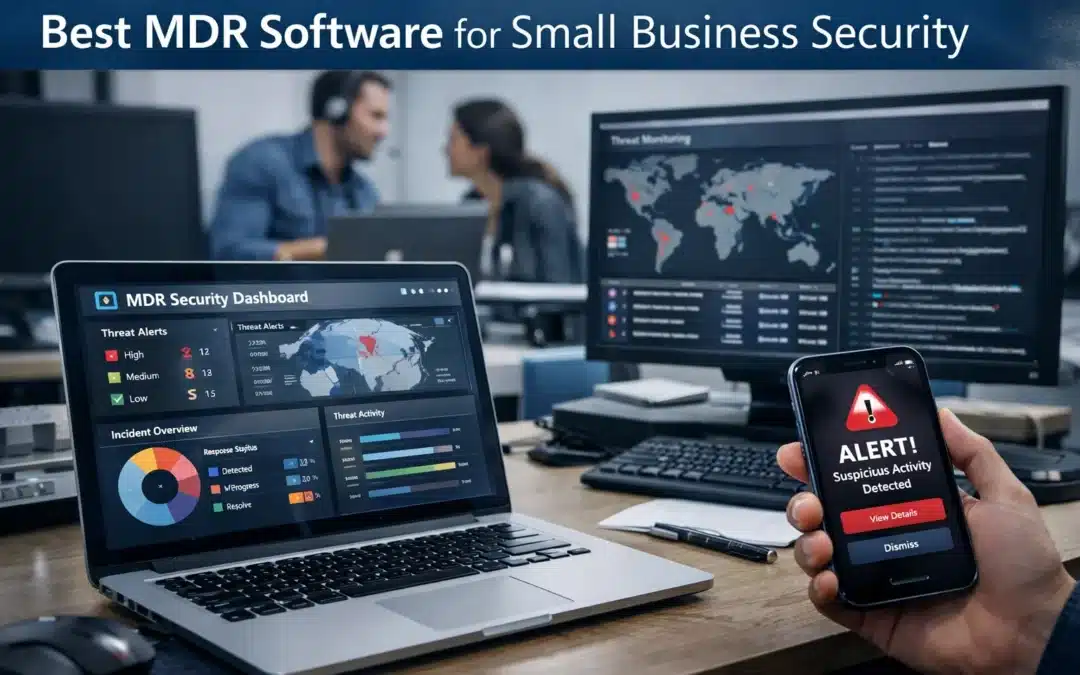
Small businesses are not the afterthought cybercriminals skip over—they’re a primary target. The best MDR software for small business security has to do more than monitor logs. It needs to detect, investigate, and respond before a threat becomes a crisis, all without requiring a full in-house security team to operate it.
With the MDR market projected to reach $15.3 billion by 2030 at a 23.5% CAGR (Grand View Research), the options are expanding fast. Knowing what separates a capable platform from a costly misfit is the real challenge.
Here are the ten features that matter most.
1. Around-the-Clock Threat Monitoring
A threat that lands at 2 a.m. on a Saturday does not wait until Monday morning. The best MDR solutions provide genuine 24/7 coverage—not just automated alerts, but human analysts who can investigate and act in real time.
According to Arctic Wolf’s 2024 Security Operations Report, 45% of security incidents are detected outside of standard business hours, with 20% occurring on weekends. A platform that only covers business hours leaves nearly half your exposure unmanaged. For small businesses without an internal security operations center, this round-the-clock human presence is one of the most valuable things an MDR service can provide.
2. Endpoint Detection and Response (EDR) Integration
Every laptop, mobile device, and workstation connected to your network is a potential entry point. Strong MDR software includes deep endpoint visibility—either through a built-in EDR layer or seamless integration with leading EDR tools.
What to look for:
- Behavioral monitoring that catches threat signatures alone would miss
- Automated isolation of compromised endpoints before lateral movement occurs
- Forensic detail on what happened, not just that something happened
The distinction matters for small businesses: EDR integration means you get full context on an incident, not just a vague alert. You can learn more about how advanced endpoint protection fits into a broader MDR framework.
3. Threat Hunting—Not Just Threat Detection
Reactive tools wait for an alarm to trigger. Proactive threat hunting means analysts are actively scanning your environment for indicators of compromise that haven’t surfaced yet.
This is one of the features that separates true MDR from older managed security service providers (MSSPs). MSSPs historically forwarded alerts to your team; MDR providers go looking. For small businesses that can’t dedicate staff to proactive hunting, having this built into the service is a meaningful advantage rather than a premium add-on.

4. Alert Triage and False Positive Reduction
Alert fatigue is real. Nearly 70% of security professionals say 25–75% of the alerts they investigate daily are false positives (Integrity360). For a lean IT team at a small business, drowning in noise is as dangerous as missing a real threat.
Good MDR software filters, correlates, and prioritizes alerts before they reach you. The best platforms leverage a combination of machine learning and human analyst review, so your team only sees confirmed or high-confidence incidents—with context already attached.
| Alert Handling Approach | What It Means for Your Team |
| Raw alert forwarding | Your team investigates everything, including noise |
| Automated filtering only | Reduces volume, but misses subtle threats |
| ML + Human triage (MDR) | Validated incidents with investigation already done |
| No triage at all | Full alert burden stays in-house |
5. Network Detection and Response (NDR) Coverage
Endpoints are one side of the picture. Network traffic is the other. Threats moving laterally across your environment—or exfiltrating data through seemingly normal connections—often go undetected without network-level visibility.
Look for MDR software that monitors network traffic, detects anomalies in communication patterns, and correlates network signals with endpoint data. This combined visibility is what turns isolated alerts into a coherent picture of an attack in progress.
For small businesses migrating to cloud infrastructure, cloud-native network detection matters as much as on-premise coverage. A solution that only watches traditional network perimeters misses a growing portion of the attack surface.
6. SIEM Integration and Log Management
Security Information and Event Management (SIEM) platforms collect and correlate log data across your entire environment. MDR solutions that integrate tightly with a SIEM—or include one—give analysts far more context when investigating an incident.
The tricky part is that raw log management is complex and expensive to do well on your own. When evaluating MDR software for a small business, consider:
- Whether log ingestion is included in the service or billed separately
- How far back are logs retained for forensic investigation
- Whether the platform can ingest logs from cloud services, not just on-premise tools
Choosing the right MDR security monitoring solution involves understanding how well the platform handles data from your specific environment—not just a generic enterprise stack.
7. Rapid Incident Response and Remediation Support
Detection without response is just expensive observation. The best MDR software for businesses in 2026 includes defined incident response as part of the service, not an upsell.
This means:
- Immediate containment actions when a confirmed threat is identified
- Remote remediation support, where possible
- Clear escalation paths for incidents requiring deeper intervention
- Post-incident reporting so you understand what happened and why
Speed matters here more than most metrics. The gap between initial compromise and full lateral spread can be measured in hours. A provider that detects a threat but waits for your approval before acting can cost you more than a slower platform that acts decisively.
8. Compliance Reporting and Audit-Ready Documentation
For small businesses in regulated industries—healthcare, finance, retail—security is inseparable from compliance. HIPAA, PCI-DSS, and SOC 2 requirements don’t scale down for smaller organizations; the obligations are the same regardless of headcount.
MDR software that generates compliance-ready reports, maintains audit logs, and tracks incident timelines can reduce the manual burden significantly. Some platforms even map their detection coverage to specific regulatory frameworks, making it easier to demonstrate due diligence to auditors.
This is one area where the right MDR service benefits extend well beyond cybersecurity—directly supporting legal and regulatory obligations that carry real financial penalties.
9. Transparent Reporting and Security Posture Visibility
A small business owner or IT manager shouldn’t need a security analyst certification to understand what their MDR platform is telling them. Clear, readable dashboards and regular reporting are non-negotiable features when evaluating MDR software.
What good visibility looks like in practice:
- Executive summaries that explain risk in plain language
- Trend data showing whether your threat exposure is improving over time
- Incident logs with full timelines accessible to your team
- Regular cadence reporting—weekly or monthly, depending on your needs
Opacity is a red flag. If a vendor can’t explain what their platform detected last month and what it did about it, that’s a problem before something serious happens.

10. Scalability and Pricing Transparency for Growing Businesses
Small businesses grow. The MDR software you choose today needs to scale with you—adding endpoints, cloud workloads, or new locations without requiring a complete platform change. Equally important is pricing transparency; unpredictable per-event or per-alert billing structures can make costs difficult to forecast.
Look for:
- Flat-rate or per-endpoint pricing rather than consumption-based models
- Modular service tiers that let you add capabilities as your needs grow
- Contract flexibility, particularly if your environment changes quickly
Not all MDR pricing is designed with small businesses in mind, but the best platforms offer structured tiers that deliver enterprise-grade protection at a cost that makes sense before you hit 500 employees. Reviewing an MDR evaluator’s guide before signing any contract will help you ask the right questions.
Matching the Right Platform to Your Actual Risk Profile
There’s no universal answer to which MDR solution is “best”—only which is best for your environment. A healthcare clinic has different compliance pressures than a retail distributor. A remote-first company has different endpoint risks than one operating a single physical location.
The features above form a solid evaluation framework regardless of industry. Prioritize the ones that map to your biggest gaps: if your team is overwhelmed by alerts, triage matters most; if you’re facing an audit, compliance reporting moves to the top. Compare platforms against your own checklist rather than marketing claims.
For businesses that want to understand how MDR fits into a broader cybersecurity strategy vs. traditional security approaches, the difference becomes clear once you look at detection speed, analyst depth, and active response capability side by side.
ClearNetwork’s MDR service is purpose-built to cover all ten of these capabilities—offering 24/7 monitoring, expert analyst support, and compliance-ready reporting for businesses that need enterprise-level protection without an enterprise security budget. Talk to ClearNetwork’s team to see how the right MDR solution fits your specific environment.