
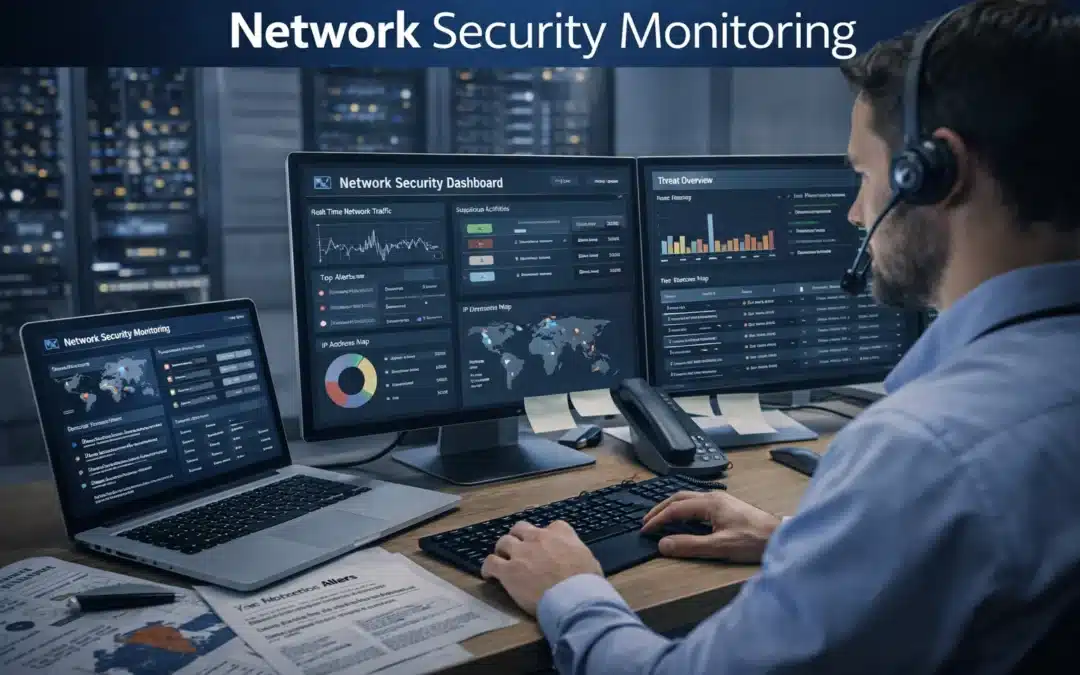
The way organizations monitor their networks has changed more in the past three years than in the previous decade. Hybrid infrastructure, cloud-native workloads, remote endpoints, and a threat landscape that weaponizes AI have collectively forced a fundamental rethinking of what network security monitoring means — and what it needs to do.
The numbers reflect that shift. According to Mordor Intelligence, the global network security market is valued at USD 24.95 billion in 2025 and is projected to reach USD 42.93 billion by 2030, growing at a CAGR of 11.47%.
The managed services segment is growing even faster, driven by organizations that recognize the gap between what sophisticated monitoring requires and what most internal teams can realistically sustain.
Here’s what that landscape looks like heading into 2026 — and what the most significant shifts in network security and monitoring actually mean for how organizations defend themselves.
AI-Driven Detection Is Becoming the Baseline, Not a Premium Feature
A few years ago, artificial intelligence in network security monitoring tools meant a vendor checkbox and a premium price tier. In 2026, it’s becoming the operational baseline. The volume of network traffic and the sophistication of modern evasion techniques have simply outpaced what rule-based detection can handle effectively on its own.
AI and machine learning now contribute to monitoring in several concrete ways:
- Behavioral baselining — establishing what normal traffic patterns look like for a given environment, then flagging statistically significant deviations rather than matching against known-bad signatures
- Anomaly correlation — connecting individually unremarkable signals across endpoints, network flows, and identity logs into patterns that indicate attack progression.
- Noise reduction — filtering low-confidence alerts before they reach analyst queues, reducing the false-positive burden that causes genuine threats to be deprioritized
- Adaptive thresholds — adjusting detection sensitivity based on time of day, user role, and historical behavior rather than applying fixed rules across all traffic
The practical implication is significant. Organizations relying on purely signature-based security monitoring tools are increasingly blind to threats that don’t match known patterns, which describes a growing proportion of modern attacks. AI-assisted detection isn’t perfect, but its coverage of novel and evolving threats meaningfully exceeds what legacy approaches deliver.
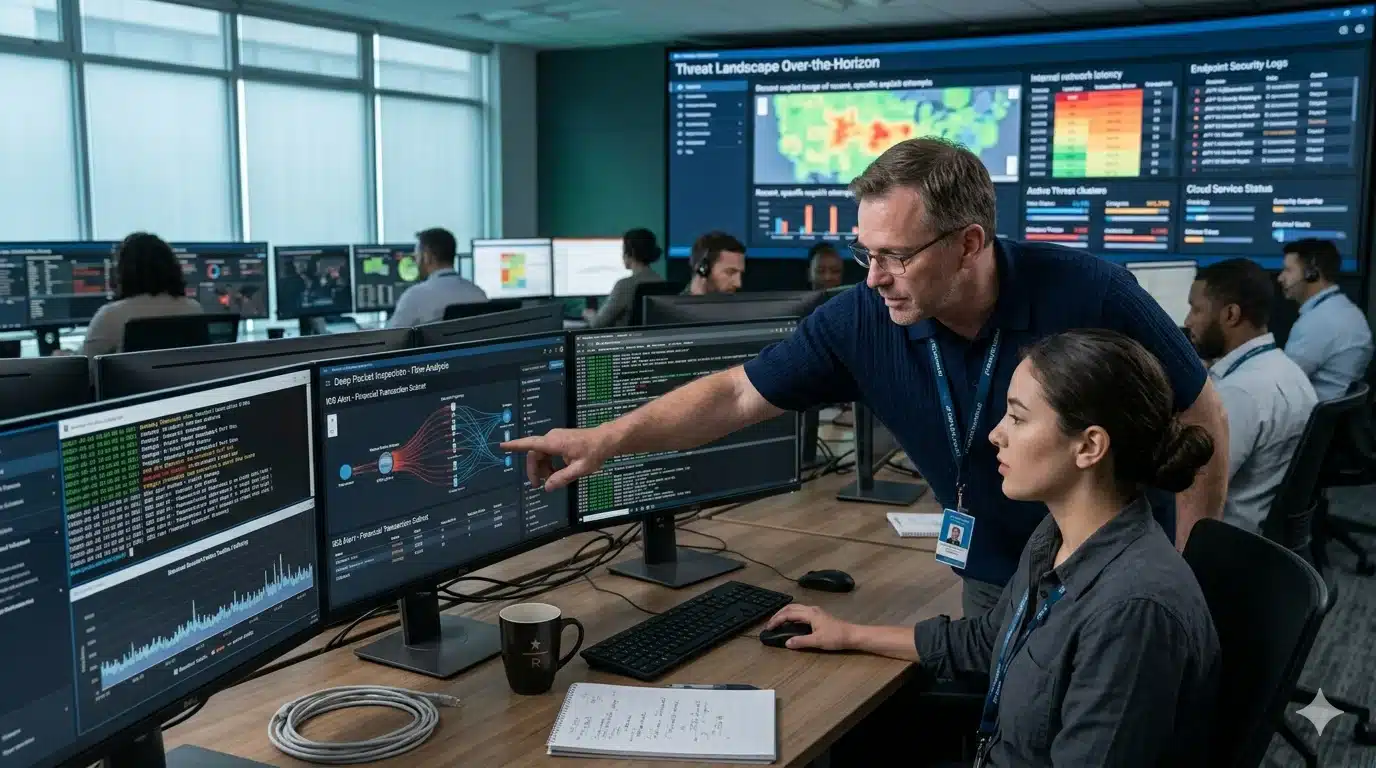
Zero-Trust Architecture Is Reshaping What Monitoring Has to Watch
Zero-trust network access has moved from an architectural principle to operational reality for a growing number of organizations. As it does, network security and monitoring must adapt: a zero-trust environment doesn’t rely on a hardened perimeter to keep threats out, which means the monitoring layer has to be comprehensive enough to catch malicious activity that originates from inside trusted zones.
This changes the monitoring mandate in a few important ways.
East-West Traffic Becomes Critical Visibility
Traditional perimeter-focused monitoring watched north-south traffic — data moving in and out of the network. Zero-trust environments require equally rigorous monitoring of east-west traffic — lateral movement between internal systems.
An attacker who has established a foothold inside the network should generate detectable signals as they move toward high-value targets. Without east-west visibility, that movement goes undetected until damage is done.
Identity and Access Signals Feed Into Network Monitoring
In a zero-trust model, identity is a core security control — access is granted based on verified identity and context, not network location. That means identity-related signals — failed authentication attempts, unusual access patterns, privilege escalation — become an integral part of network security monitoring data, not a separate domain.
The best monitoring tools in 2026 correlate network traffic with identity and access data to surface attack patterns that neither source would reveal alone.
Network Detection and Response (NDR) Has Replaced Traditional IDS/IPS
Intrusion Detection Systems and Intrusion Prevention Systems served an important function for years, but their architectural limitations have become increasingly difficult to work around. Signature-dependent detection, limited coverage of encrypted traffic, and alert-heavy output with minimal context have pushed organizations toward Network Detection and Response as a more capable replacement.
NDR platforms bring several meaningful improvements:
| Capability | Traditional IDS/IPS | Modern NDR |
| Detection approach | Signature-based | Behavioral + AI-assisted |
| Encrypted traffic coverage | Limited | Deep packet analysis with metadata |
| Alert context | Minimal — event data only | Full traffic context + threat correlation |
| Response capability | Alert only | Automated containment actions |
| East-west visibility | Typically absent | Core coverage area |
The shift to NDR isn’t cosmetic. Organizations that have moved from legacy IDS deployments to NDR-based network security monitoring tools report fewer false positives, faster investigation timelines, and meaningful improvement in detecting lateral movement — precisely the threat category that traditional tools miss most consistently.
Cloud-Native Monitoring Has Become Mandatory, Not Optional
Cloud workloads now account for a majority of enterprise compute, and that proportion continues to grow. Network security monitoring built for on-premise environments doesn’t translate cleanly to cloud-native infrastructure — the traffic patterns, identity models, and control planes are fundamentally different.
Effective cloud-native network security and monitoring requires:
- Cloud-native sensor deployment that doesn’t require traffic backhaul to on-premise monitoring infrastructure
- API-level visibility into cloud service interactions, not just network flow data
- Multi-cloud correlation that connects signals across AWS, Azure, and GCP environments without treating each as a separate monitoring domain
- Container and microservices awareness — east-west traffic between containers generates monitoring challenges that traditional tools weren’t designed to address
Organizations running hybrid environments face the additional challenge of maintaining consistent monitoring coverage across both on-premise and cloud infrastructure without creating visibility gaps at the boundary between them.
This is where choosing the right managed detection and response monitoring solution becomes particularly consequential — providers with native multi-environment coverage deliver meaningfully different outcomes than those with cloud capabilities bolted onto primarily on-premise platforms.
The Integration Layer Between Network Monitoring and Response Has Narrowed
One of the persistent failure modes in security operations has been the gap between detection and response. A network security monitoring tool flags an anomaly; an analyst investigates; a decision is made; containment actions are executed. Each handoff introduces latency, and latency is exactly what sophisticated attackers exploit.
In 2026, the integration between network security monitoring and active response is tightening in two ways:
- Automated response playbooks — when monitoring tools detect high-confidence threats matching defined criteria, automated actions execute without waiting for analyst confirmation. Isolating a compromised endpoint, blocking a malicious IP at the firewall, or revoking a session token can all happen in seconds rather than minutes.
- Unified analyst workflows — platforms that present monitoring alerts, investigation context, threat intelligence enrichment, and response actions in a single interface reduce the cognitive load on analysts and accelerate time-to-containment. The best monitoring tools no longer hand off to a separate response tool; they make response a native capability.
This convergence is part of why the distinction between network security monitoring, NDR, and MDR is increasingly blurring. The underlying capability is continuous, intelligent, network-level visibility connected to a response layer — whatever label vendors apply to it.
For a deeper look at how that convergence plays out operationally, ClearNetwork’s explanation of what managed detection and response actually involves is a useful reference point.

The Skills Gap Is Accelerating the Move to Managed Network Monitoring
The ISC2 2024 Cybersecurity Workforce Study puts the global cybersecurity workforce gap at nearly 4.8 million unfilled positions. Network security monitoring is particularly affected — effective continuous monitoring requires analysts who can distinguish meaningful anomalies from background noise, and that capability takes years of experience to develop.
The talent shortage is reshaping how organizations structure their security operations. Building and staffing an internal monitoring function from scratch is a multi-year project even under favorable hiring conditions. For most organizations, managed network monitoring services represent the faster, more economical path to comprehensive coverage.
That said, not all managed services deliver equally. The critical distinction is whether the provider offers genuine analyst-led monitoring with defined response capability, or primarily operates as an alert relay that still leaves investigation and response to the client’s team.
The difference matters enormously in practice — and it’s worth examining carefully before any contract is signed. ClearNetwork’s SIEM and log management services page outlines how analyst-backed monitoring integrates with structured log correlation in a fully managed model.
What Organizations Should Prioritize in Their Strategy
Network security monitoring in 2026 is not a product category — it’s a continuous capability that requires the right combination of technology, intelligence, and human expertise to function effectively.
ClearNetwork provides managed network security monitoring built for organizations that need enterprise-grade coverage without the overhead of building and staffing that capability internally. Contact ClearNetwork to discuss how the right monitoring approach fits your environment and risk profile.