

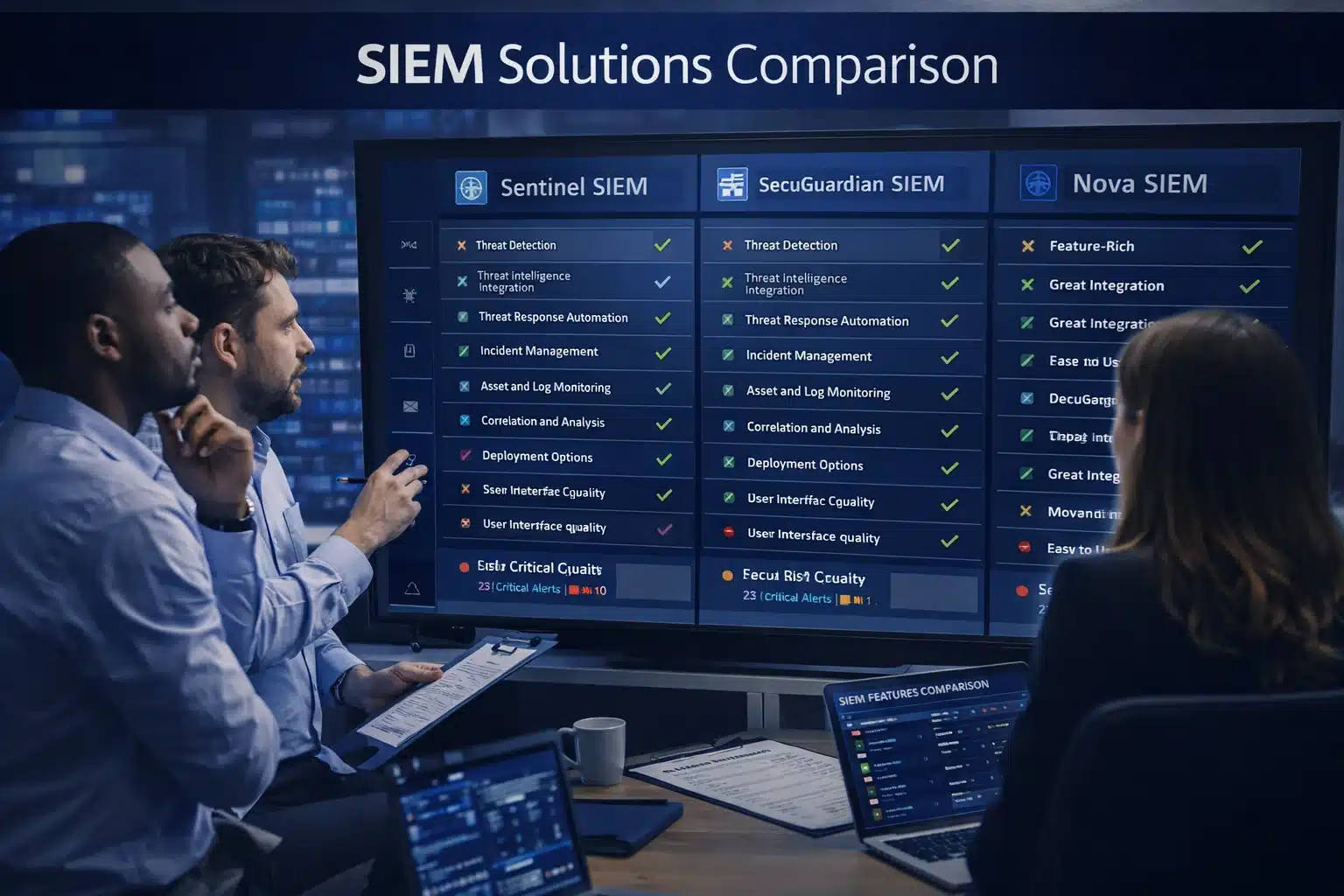
Any meaningful SIEM solutions comparison has to go beyond spec sheets. Feature parity across major platforms has grown significantly — most enterprise-grade tools now check the same foundational boxes. What actually separates them is detection architecture, pricing transparency, integration depth, and whether the platform reduces analyst workload or adds to it.
This guide covers the leading platforms on these dimensions, with a practical look at how pricing structures translate into real costs over time.
What a Useful SIEM Tools Comparison Actually Measures
Before platform profiles, it helps to define what matters in any SIEM tools comparison. The standard feature list — log collection, correlation rules, alerting, compliance reporting — no longer meaningfully differentiates vendors. Organizations evaluating platforms in 2025 should focus on:
- Detection depth: Does the platform rely on signature-based rules, behavioral analytics, or a combination? Rule-based detection misses novel threats that behavioral engines catch.
- AI and ML integration: Genuine machine learning that adapts to your environment differs meaningfully from static anomaly thresholds labeled as AI.
- Pricing model risk: Consumption-based pricing can spike unpredictably as log volumes grow. Flat-rate and per-entity models offer better cost predictability.
- Time-to-value: How quickly can the platform provide meaningful detection coverage after deployment — not just data ingestion?
- Integration breadth: Native connectors to EDR, identity platforms, cloud workloads, and ticketing systems matter. Every custom integration adds maintenance overhead.
According to Mordor Intelligence, the global SIEM market stood at USD 10.78 billion in 2025 and is forecast to reach USD 19.13 billion by 2030 at a 12.16% CAGR. Vendor roadmaps now center on AI-powered analytics, unified data pipelines, and simplified licensing — platforms that haven’t made meaningful progress on those dimensions deserve extra scrutiny regardless of historical reputation.
Microsoft Sentinel
Sentinel is the default evaluation candidate for any Microsoft-first environment. Its cloud-native architecture on Azure Log Analytics scales without infrastructure overhead, and its native integration with Defender, Entra ID, and Microsoft 365 gives it correlated visibility across identity, endpoint, and cloud layers that third-party platforms can’t match within the Microsoft ecosystem.
Key Capabilities
Sentinel’s UEBA layer profiles user and device behavior continuously, surfacing anomalies that rule-based detection would miss. The Microsoft Security Copilot integration brings generative AI into investigation workflows, letting analysts query incident data in natural language and reducing the skill floor needed to operate the platform effectively.
Pricing
Consumption-based (GB/day ingestion plus retention). Microsoft 365 E5 customers receive a daily data grant that subsidizes Sentinel meaningfully. Without E5, costs scale directly with log volume — a significant consideration for data-heavy environments where unexpected volume spikes create billing surprises.
Best fit: Microsoft-heavy organizations with E5 licensing, teams prioritizing unified identity and endpoint correlation.
Splunk Enterprise Security (Cisco)
Cisco’s 2024 acquisition of Splunk repositioned the platform within a broader network and observability stack. Splunk Enterprise Security remains the most customizable SIEM available — SPL (Search Processing Language) provides query depth no competing platform matches, and its data model flexibility allows ingestion of virtually any source.
Key Capabilities
Mission Control consolidates alert triage, investigation, and response into a single analyst workflow. Native SOAR integration supports sophisticated automated response playbooks. For organizations with dedicated security engineering resources, the ceiling on what Splunk can be configured to do is genuinely unmatched.
Pricing
Traditional ingest-based licensing penalizes high-volume environments. Entity-based licensing options exist but require careful contract negotiation. Post-acquisition pricing restructuring is ongoing — organizations should model multiple volume scenarios before committing. ClearNetwork’s guide to optimizing your security budget and SIEM pricing covers what to evaluate beyond headline numbers.
Best fit: Large enterprises with mature security operations and engineering depth to realize the platform’s full capability.
Exabeam Fusion
The Exabeam-LogRhythm merger created the largest pure-play SIEM vendor in the market, combining UEBA-first detection with LogRhythm’s compliance infrastructure — a pairing that addresses two gaps organizations consistently identify in competing platforms.
Key Capabilities
Smart Timelines automatically constructs the full event sequence surrounding an anomaly — what happened before, during, and after — without requiring analysts to manually correlate log data.
This compression of investigation time is one of the most operationally meaningful capabilities in the current market. Compliance frameworks for HIPAA, PCI-DSS, SOX, and GDPR come pre-built, generating audit-ready reports without manual configuration.
Pricing
Flat-rate and consumption-based options are both available. The flat-rate model — unlimited data ingestion at a fixed price — is a genuine differentiator for data-heavy environments where per-GB pricing creates budget unpredictability.
Best fit: Compliance-heavy industries, organizations prioritizing investigation speed, environments where log volume makes per-GB pricing untenable.
Securonix
Securonix built its position on cloud-native architecture and AI-driven detection. Its Snowflake-based data lake backend handles high-volume, continuous telemetry particularly well, and its threat content library includes hundreds of pre-built detection models that accelerate time-to-value compared to platforms requiring custom detection development from scratch.
Key Capabilities
The Spotter natural language interface allows analysts to investigate incidents without specialized query language knowledge. A built-in managed detection and response layer lets organizations offload ongoing operations to Securonix’s analyst team without switching platforms — a useful path for teams whose security needs are growing faster than their internal capacity.
Pricing
Consumption-based, tied to user count and data ingestion. Cloud-native architecture eliminates on-premise infrastructure overhead, reducing the total cost of ownership in direct comparisons against legacy deployments.
Best fit: Cloud-first organizations, mid-market security teams prioritizing AI-assisted detection with lower operational overhead.
SIEM Pricing Comparison: Models Side by Side
| Pricing Model | How It Works | Cost Risk | Best For |
| Consumption (GB/day) | Charged per volume of data ingested | Spikes with log growth | Lower-volume, predictable environments |
| Entity-based | Charged per user or device | Predictable, scales with headcount | Organizations with stable asset counts |
| Flat-rate | Fixed price for unlimited ingestion | Minimal cost variability | High-volume environments |
| EPS/FPM | Charged per event and flows per second | Expensive in high-traffic environments | Legacy deployments |
IDC’s 2024 Worldwide Views of SIEM Survey, as reported by Expert Insights, found that 32% of organizations cite the requirement for dedicated staff as their top challenge in using their SIEM to its full capability. Pricing model alone doesn’t determine total cost — operational overhead, tuning complexity, and analyst capacity all factor into what a platform actually costs to run long-term.

The Managed SIEM Path
Not every organization should run a SIEM independently. Any of the platforms above requires skilled personnel for configuration, ongoing tuning, and analyst coverage to act on what the platform surfaces. An enterprise-grade SIEM running with minimal tuning and understaffed analysts produces noise — not intelligence.
Managed SIEM services address this gap by providing continuous platform management alongside analyst-backed monitoring, without requiring organizations to build that expertise internally. For a detailed look at what to evaluate in managed providers, ClearNetwork’s overview of managed SIEM solutions covers SLA structure, analyst depth, and what “managed” realistically covers.
Choosing the Right Platform
A practical SIEM solutions comparison always returns to the same question: which platform can your team actually operate effectively against the threats your environment faces? Sentinel wins in Microsoft-first organizations. Splunk rewards teams with engineering depth. Exabeam earns its place in compliance-heavy environments. Securonix fits teams that need strong detection without heavy operational overhead.
Pricing model matters as much as feature set. Understanding SIEM as a service pricing in 2025 helps organizations build realistic cost models before committing to any vendor. ClearNetwork works with organizations to evaluate, deploy, and manage SIEM platforms matched to their specific security requirements — including whether a managed approach delivers better outcomes than self-managed deployment. Contact ClearNetwork to discuss which platform and model fits your operations and budget.