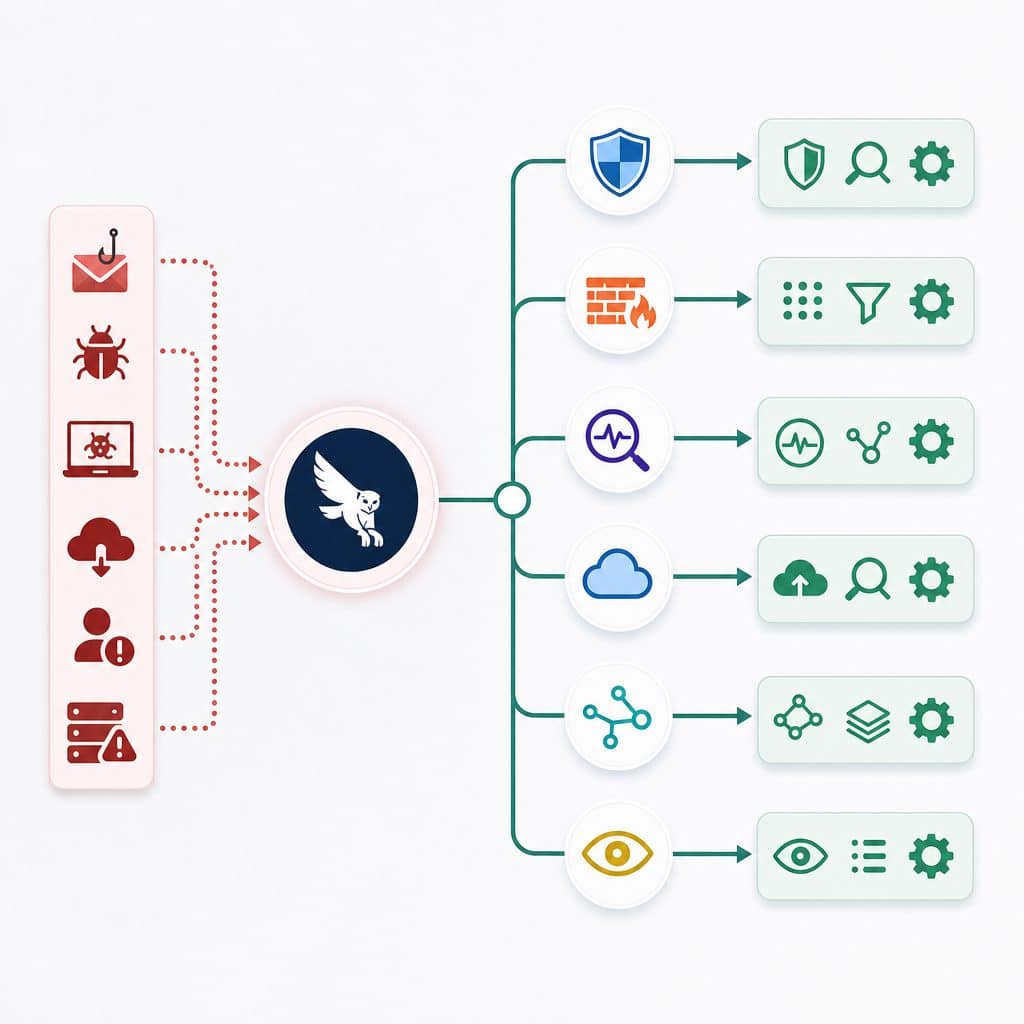
Huntress has earned attention because many small and mid-sized organizations need practical managed detection without building a full-time SOC. Its managed EDR, identity protection, and ransomware canaries solve real problems for lean IT teams. Yet alternatives matter when your environment grows, your compliance burden expands, or your executives want broader coverage across endpoints, cloud, identity, network, email, and logs.
The best alternative is not always another single platform. Often it is a better operating model: skilled analysts running the tools you already own, tuning detections, investigating alerts, coordinating response, and proving progress to leadership. Clearnetwork approaches this decision as an operations question, not a logo comparison.
This guide explains where Huntress fits, when buyers evaluate alternatives, how MDR, SOC as a Service, managed EDR, and SIEM options differ, and what to ask before changing providers.
As security programs mature, common pressure points appear. A company may need 24/7 coverage for a regulated business unit, deeper SIEM correlation for audit evidence, a managed CrowdStrike deployment, or help rationalizing overlapping tools. Other teams want incident response guidance from analysts who understand firewall telemetry, vulnerability findings, identity signals, and business priorities, not only endpoint events.
Verizon’s 2024 Data Breach Investigations Report continues to show the human element and credential abuse as recurring breach drivers. IBM’s 2024 Cost of a Data Breach Report puts the global average breach cost near 4.88 million dollars. Those numbers explain why buyers are asking whether their provider can reduce dwell time, document decisions, and move fast during ransomware or account takeover.
Buyers usually compare four categories. Each can be valid, but each has different operational consequences.
MDR services combine technology with analyst-led investigation and response. They are best when you need active threat handling, not only notifications.
A managed SOC centralizes monitoring across SIEM, EDR, firewall, identity, cloud, and other signals with escalation processes and reporting.
Managed EDR focuses on endpoint deployment, policy tuning, alert triage, containment, and endpoint response actions across laptops and servers.
SIEM operations emphasize log onboarding, correlation rules, compliance reports, retention, threat hunting, and cross-tool context for investigations.
For many organizations, the strongest Huntress alternative is a provider that can operate multiple layers together. Clearnetwork supports clients with Managed Detection and Response, Managed SOC Services, and tool-specific expertise such as Managed CrowdStrike when endpoint programs require deeper administration and alert triage.
Use this matrix to frame the discussion with executives and technical stakeholders. The goal is not to declare a universal winner; it is to match controls to risk, coverage, staffing, and budget.
| Option | Best fit | Watch points | Operational outcome |
|---|---|---|---|
| Huntress | Lean teams wanting practical managed endpoint and identity protection | May be narrower than a full SOC model | Faster coverage for common attacks with lower operational burden |
| MDR provider | Organizations needing analyst-led detection response and containment | Quality depends on integrations playbooks and escalation rights | Better incident handling and reduced internal workload |
| SOC as a Service | Businesses needing 24/7 monitoring across many telemetry sources | Requires log strategy use cases and governance | Broader visibility and audit-ready monitoring |
| Co-managed SIEM | Regulated teams with existing logging investments | Can fail without tuning ownership and response processes | Stronger evidence reporting and correlation |
| Managed EDR | Organizations standardizing on CrowdStrike Microsoft Defender SentinelOne or similar tools | Endpoint control is only one part of the attack path | Improved endpoint hygiene triage and containment |
If you already own a SIEM or need compliance reporting, ask whether the provider can manage parsing, enrichment, rule tuning, retention, and evidence packages. Clearnetwork helps organizations operate SIEM monitoring and related workflows without leaving detection logic unmanaged after implementation.
Feature lists often hide the hard parts of security operations. Before replacing or augmenting Huntress, test each alternative against the work that happens at 2:00 a.m., during an audit, or after a suspicious administrator login.
Also confirm contract assumptions. Some offers look inexpensive because they cover a limited number of devices, exclude cloud telemetry, provide business-hours response, or require your team to perform containment. A more complete service may cost more on paper but reduce breach impact, overtime, audit effort, and executive uncertainty.
Huntress-style managed detection can be an excellent layer, especially for organizations that need endpoint-focused ransomware defense. A managed SOC becomes more attractive when the business needs continuous monitoring across the security stack. Examples include multi-location healthcare, financial services, manufacturers with operational downtime risk, and professional services firms handling sensitive client data.
A strong 24/7 managed SOC should correlate events from EDR, SIEM, identity providers, firewalls, email security, and cloud platforms. It should also maintain runbooks, severity definitions, escalation contacts, and post-incident improvement actions. That operational scaffolding matters because attackers rarely stay inside one product boundary.
Clearnetwork often sees buyers struggle after purchasing strong tools without assigning ownership for hygiene and response. A SOC service closes that gap by making monitoring measurable: what was reviewed, what was escalated, what changed, and what risks remain.
Depending on scope, organizations may evaluate several product and service paths. CrowdStrike Falcon, Microsoft Defender XDR, SentinelOne, Sophos MDR, Arctic Wolf, Rapid7 MDR, Red Canary, Expel, and managed Microsoft Sentinel providers commonly appear in shortlists. The right choice depends on telemetry depth, integration quality, response authority, regional coverage, pricing transparency, and your internal team’s skill set.
Platform strength does not eliminate operational responsibility. CrowdStrike, for example, can provide excellent endpoint telemetry and response capabilities, but someone still needs to manage prevention policies, investigate detections, understand sensor health, and coordinate containment with business owners. That is why many organizations pair leading tools with an MSSP rather than replacing people with software.
If your team is moving from a narrower service to a broader program, avoid buying every missing feature at once. Start with business-critical assets, privileged identities, remote access, backup resilience, and internet-facing systems. Then expand telemetry and playbooks in phases so operations stay stable.
Use vendor conversations to test operational maturity, not sales polish. Good providers answer directly and explain tradeoffs in plain language.
The answers should reveal whether you are buying software coverage, analyst capacity, or a true operating partnership. For lean teams, that distinction determines whether security becomes calmer and more measurable or simply noisier.
Comparing subscription prices alone can mislead buyers. The real economic question is what it would cost to provide equivalent coverage internally. A modest SOC requires analysts across shifts, engineering time, escalation coverage, management oversight, training, threat intelligence, and tooling. Attrition and burnout add risk because security operations is relentless work.
Industry data reinforces the point. Mandiant’s M-Trends reports continue to emphasize detection speed and investigation quality as differentiators in real incidents. CISA guidance repeatedly stresses layered defenses, tested response plans, and logging visibility. Those are operational capabilities, not checkbox features.
A useful alternative should convert spend into outcomes: fewer unmanaged alerts, faster containment, stronger evidence for auditors, better executive reporting, cleaner tool configuration, and clearer roles during incidents. If the provider cannot explain how value is measured, expect difficulty defending the budget later.
Clearnetwork is not positioned as another point product competing feature by feature with Huntress. We help organizations run security programs across the technologies they choose. That includes monitoring, tuning, integration support, investigation, response coordination, reporting, and practical guidance for improving controls over time.
For some clients, the answer is to keep Huntress and add broader SOC visibility. For others, it is to standardize on CrowdStrike, Microsoft Defender, SentinelOne, AlienVault, Microsoft Sentinel, or another stack with managed operations around it. The important decision is who will own the daily work that keeps those tools effective.
Clearnetwork brings MSSP discipline to that daily work: use case prioritization, alert validation, escalation design, stakeholder communication, and continuous improvement. We also help leaders translate technical activity into business evidence, which is essential for boards, insurers, customers, and regulators.
Changing providers should not create a monitoring blind spot. Treat the move as a controlled transition with clear rollback options.
This discipline prevents the common failure pattern: buying a better service but leaving asset ownership, identity hygiene, logging gaps, or executive expectations undefined.
It can be a strong layer, especially for endpoint-focused ransomware protection. If the business needs broader log monitoring, cloud visibility, compliance evidence, or 24/7 analyst escalation, evaluate MDR or managed SOC support.
Start with gaps. If Huntress is working on endpoints but identity, SIEM, cloud, or response ownership is weak, augmentation may be safer than replacement. If coverage overlaps heavily, consolidation may reduce cost and complexity.
Choosing based on dashboard features instead of operating responsibility. Ask who investigates, who tunes, who responds, and who explains risk to leadership.
If you are comparing Huntress alternatives, Clearnetwork can help you assess coverage, staffing, tooling, response needs, and migration options. Get an objective view of the operating model that will reduce risk without adding unnecessary complexity for your security team and executives before you commit budget this quarter.
Cut EDR alert fatigue without creating blind spots. Learn to prioritize high-risk signals, automate enrichment,…
Secure third-party remote access with MFA, accountable owners and complete visibility—critical as vendors feature in…
Turn PCI DSS 4.0.1 monitoring into faster payment threat response—master Requirements 10, 11 and 12,…
Protect plant uptime with passive OT security monitoring. Map legacy assets, baseline traffic, and detect…
Contain a Microsoft 365 BEC in 24 hours: revoke sessions, preserve evidence, stop payment fraud,…
Make SIEM costs predictable with a 4-layer TCO model covering licensing, data ingestion, security operations…