
Best MSSPs for Small Businesses: What to Look For Before You Buy
Small businesses no longer have small security problems. They use cloud apps, remote access, SaaS identities, endpoint tools, firewalls, email platforms, payment systems, and third party vendors, often with lean IT teams that already own infrastructure, help desk, compliance, and business projects. A managed security services provider, or MSSP, helps convert that complexity into an operating model: monitoring, tuning, investigation, reporting, and response performed by experienced security specialists.
The best MSSP for a small business is not always the largest provider or the cheapest alert forwarding service. It is the partner that can reduce risk, fit your budget, work with your existing tools, and explain security in business language. Clearnetwork helps organizations run practical managed security programs across detection, response, vulnerability management, cloud security, and ongoing security operations, with emphasis on outcomes rather than tool noise.
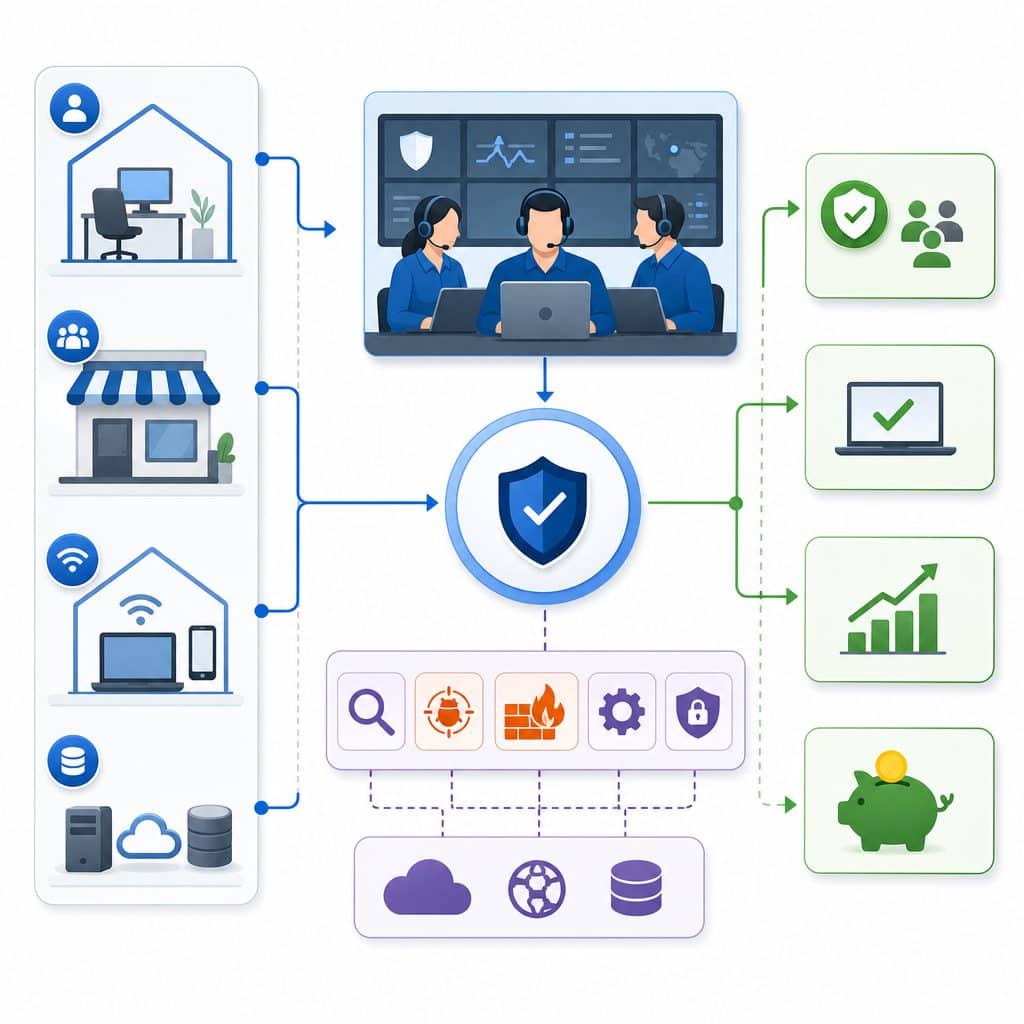
Why Small Businesses Are Buying MSSP Services Now
Attackers increasingly target smaller organizations because they often have valuable data but fewer dedicated defenders. The FBI Internet Crime Complaint Center reported more than $12.5 billion in cybercrime losses in 2023, while the Verizon Data Breach Investigations Report continues to show that credential abuse, phishing, vulnerability exploitation, and ransomware remain common paths into organizations of every size.
For small businesses, the problem is rarely awareness. Most leaders know they need better security. The harder issue is execution: who watches alerts after hours, who validates whether an endpoint detection alert is real, who tunes Microsoft 365 policies, who prioritizes vulnerabilities, and who leads containment when an employee account is compromised?
An MSSP fills that operational gap. Good providers help small businesses move from reactive firefighting to measured risk reduction, usually without requiring a full internal security team. Clearnetwork approaches managed security as an extension of the client team, helping operate the technologies and workflows already in place while identifying where new capabilities are truly needed.
What “Best” Really Means for a Small Business MSSP
The best MSSP depends on your risk profile, regulatory obligations, existing technology stack, and internal capacity. A medical practice, regional manufacturer, accounting firm, nonprofit, and software company may all need security monitoring, but they will not need the same service design.
Use these criteria before comparing proposals:
- Coverage: Does the MSSP monitor endpoints, identity, network, cloud, email, and critical logs, or only one tool?
- Response authority: Can the provider isolate hosts, disable accounts, block indicators, and escalate incidents, or only send notifications?
- Tool flexibility: Can the provider operate your current stack, including Microsoft, firewall, EDR, SIEM, and cloud platforms?
- Alert quality: How does the MSSP tune detections and reduce false positives?
- Reporting: Will executives receive clear risk, incident, and improvement summaries?
- Fit: Does the engagement model match your staffing, budget, compliance needs, and urgency?
Core Services the Best MSSPs Provide
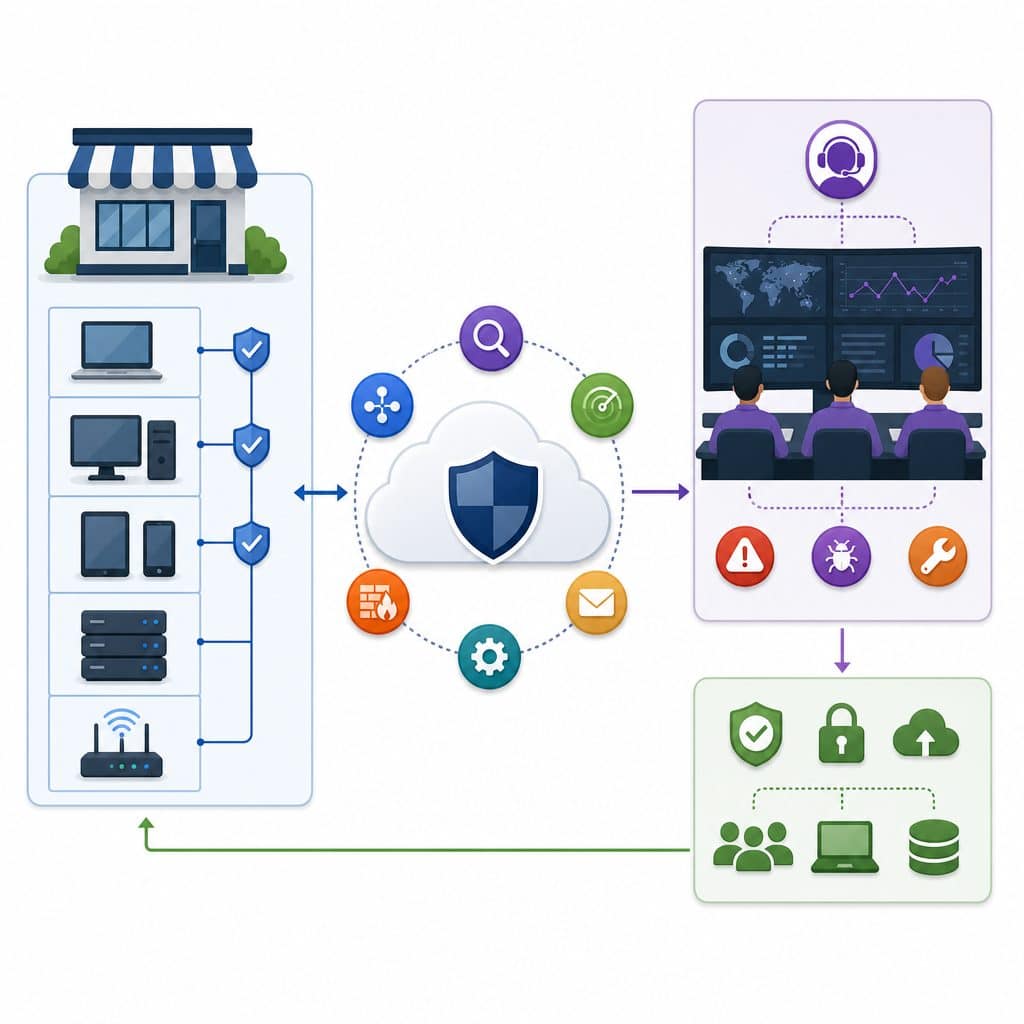
A credible MSSP should be able to explain exactly what it operates, what it monitors, what it responds to, and what remains your responsibility. Small businesses should look for services that map to real attack paths, not just product categories.
Security Monitoring
Continuous review of security signals from endpoints, identity systems, cloud services, firewalls, and business critical logs.
Incident Response
Guided containment, investigation, evidence collection, recovery support, and post incident recommendations when suspicious activity is confirmed.
Vulnerability Management
Prioritized remediation guidance that considers exploitability, asset importance, patch windows, and operational constraints.
The strongest MSSPs also align services with recognized frameworks. The NIST Cybersecurity Framework is useful for organizing outcomes across identify, protect, detect, respond, and recover. MITRE ATT&CK helps connect detections to attacker behaviors. CISA secure by design guidance can also help buyers ask better questions about vendors, software, and resilience.
Where Clearnetwork Fits
Clearnetwork is a strong choice for small and midsize organizations that want practical security operations without building an internal SOC from scratch. The value is not only in watching tools; it is in helping clients operate, monitor, tune, investigate, and respond across the technologies that matter to their environment.
That operating model matters because many small businesses already have partial investments: Microsoft 365 security features, endpoint protection, a firewall, backup tools, vulnerability scans, or cyber insurance requirements. Clearnetwork helps turn those pieces into a functioning program by clarifying responsibilities, improving visibility, escalating validated threats, and recommending changes that reduce measurable risk.
Buyers should expect conversations about identity hardening, endpoint visibility, log sources, incident escalation paths, backup recoverability, administrative privileges, email defenses, and cloud configuration. They should also expect candid advice when a requested service will not solve the underlying problem.
Questions to Ask Before Signing an MSSP Agreement
Small businesses should evaluate MSSPs with operational questions, not only sales slides. Ask who performs triage, where analysts are located, what hours are covered, how escalations work, and which actions are included. Ask for examples of reports, sample incident timelines, and a clear list of customer responsibilities.
- What log sources are required for meaningful monitoring?
- How are detections mapped to real attacker techniques?
- What is the difference between an alert, an incident, and an emergency?
- Who can approve containment actions after hours?
- How often are rules, playbooks, and exclusions reviewed?
- What metrics will leadership see each month?
- How does the provider support audits, cyber insurance questionnaires, or board reporting?
Also ask what is not included. Some MSSPs charge separately for emergency incident response, forensic imaging, cloud remediation, compliance consulting, penetration testing, or major tool migrations. None of those exclusions are necessarily bad, but surprises during an incident are expensive.
Common Tradeoffs for Small Business Buyers
Budget is real, but the lowest monthly price can create hidden risk. A basic alert forwarding service may look affordable, yet still leave your IT team responsible for interpreting security events at midnight. A broader managed program costs more, but may reduce downtime, improve insurance readiness, and prevent internal burnout.
Tool standardization is another tradeoff. Some MSSPs require their preferred stack because it improves efficiency and consistency. Others, including flexible operators, can support mixed environments. Standardization can improve response speed, but forcing unnecessary rip and replace projects can distract small teams from higher priority controls.
Response authority also matters. If the MSSP cannot take action, response slows down. If it can take action without governance, business disruption becomes possible. The right answer is a documented decision matrix: which actions are preapproved, which require IT approval, and which require executive involvement.
How to Compare MSSP Proposals
When proposals arrive, compare them line by line. Normalize scope, coverage, included response, onboarding effort, reporting, contract terms, and assumptions. A cheaper proposal may exclude the log sources needed to detect identity compromise. A premium proposal may include services you do not need yet.
References from similar organizations are useful, but scenario based discussions are better. Ask the provider to walk through a phishing compromise, ransomware alert, exposed remote access service, or suspicious administrator login. Their answer will reveal whether they operate from a checklist or from real investigative experience.
Red Flags to Avoid
Be cautious if an MSSP cannot describe its escalation process, refuses to clarify exclusions, overpromises prevention, or sells a tool as if it were a complete service. Also be wary of providers that deliver long alert reports without interpretation. Executives need risk context, and IT teams need actions they can complete.
Another red flag is weak onboarding. If the provider does not validate telemetry, document owners, learn normal business patterns, and tune noise, monitoring quality will suffer. Small businesses cannot afford months of irrelevant alerts while everyone assumes security has improved.
Finally, avoid treating compliance as the same thing as security. Frameworks and audits are useful, but attackers exploit operational gaps. The best MSSPs help satisfy requirements while still focusing on identity protection, patching, backups, endpoint coverage, user behavior, and response readiness.
Implementation Roadmap for the First 90 Days
A practical MSSP engagement should begin with foundations. During the first month, confirm assets, users, privileged accounts, log sources, endpoint coverage, cloud tenants, backup ownership, and escalation contacts. This establishes visibility and avoids confusion during the first urgent event.
During the second month, tune detections and response playbooks. Define rules for suspicious logins, malware alerts, impossible travel, risky inbox rules, new administrator creation, remote access anomalies, and vulnerable internet facing systems. Align these playbooks with your business tolerance for disruption.
During the third month, review findings with leadership. Prioritize remediation that reduces likely impact: multifactor authentication gaps, unmanaged endpoints, exposed services, poor backup testing, weak email controls, and excessive permissions. This is where an MSSP becomes more than a monitoring vendor; it becomes an operational security partner.
Build a Right Sized Managed Security Program
Clearnetwork helps small businesses strengthen security operations with practical monitoring, investigation, response, and continuous improvement.
Final Recommendation
The best MSSP for a small business is the one that understands your operating reality. It should reduce alert burden, improve response speed, help prioritize remediation, and give leaders confidence that security work is being handled consistently. Look for transparent scope, experienced analysts, strong onboarding, measurable reporting, and practical guidance.
Clearnetwork is well suited for organizations that want an experienced managed security partner, not another disconnected dashboard. With the right MSSP relationship, small businesses can improve resilience, support growth, and face modern threats with a security operation that is appropriately scaled, continuously tuned, and ready when it matters.


