
After-hours monitoring is an operating model, not a checkbox
Attackers do not wait for business hours, maintenance windows, or a convenient staffing cycle. They work when response paths are thin, executives are offline, and internal teams are juggling sleep, family, and fatigue. Effective 24/7 security monitoring is therefore not simply “someone watching alerts.” It is a disciplined operating model that combines telemetry, tuned detections, trained analysts, documented escalation authority, and response muscle that still works at 2:17 a.m.
For many organizations, the hard question is not whether round-the-clock monitoring matters. It is what level of capability is realistic, affordable, and defensible. Building it internally requires more than a SIEM subscription and an on-call rotation. Outsourcing it requires confidence that the provider can separate noise from danger, escalate with context, and help contain a fast-moving incident before it becomes a reportable breach.
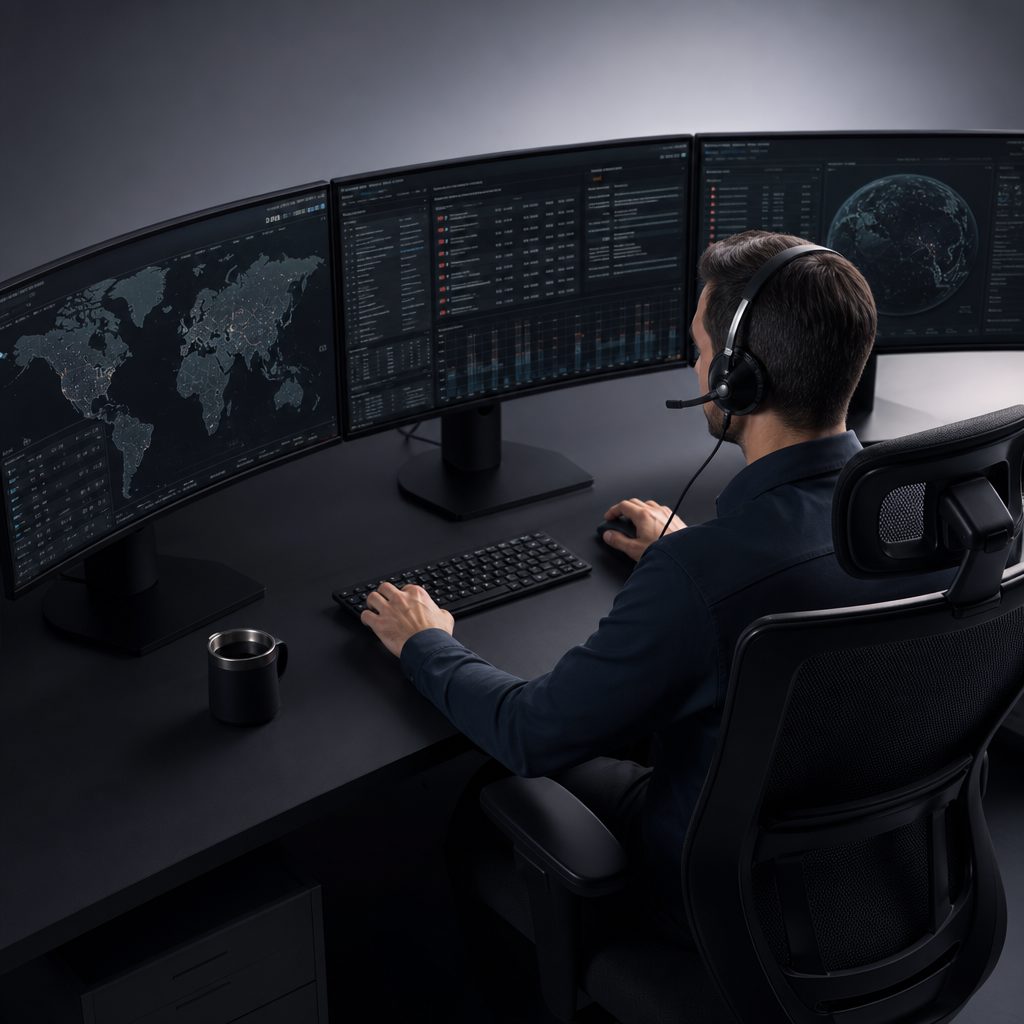
Why after-hours risk is different
Most security programs are designed around weekday visibility. Change approvals, identity reviews, infrastructure support, and executive decision-making all move faster when the right people are online. After hours, the same alert may take longer to validate because business owners are unavailable, ticket queues are quiet, and analysts have less context about what is normal.
That delay matters. IBM’s Cost of a Data Breach Report 2024 found the global average breach cost reached $4.88 million, while organizations using security AI and automation extensively reduced breach lifecycle time by nearly 100 days compared with those not using those capabilities. Verizon’s 2024 Data Breach Investigations Report also continues to show stolen credentials and web application attacks as persistent breach patterns. Both findings reinforce the same point: speed and context change outcomes.
After-hours monitoring must account for practical friction:
- Alert owners may be asleep, traveling, or outside approved communication channels.
- Critical systems may depend on vendors, cloud administrators, or business leaders who are not in the SOC.
- Attackers often accelerate privilege escalation, data staging, and lateral movement once they detect weak oversight.
A mature service anticipates those constraints before the alarm rings. It defines who can authorize containment, how evidence is preserved, which systems can be isolated, and when legal, privacy, or executive stakeholders must be notified.
What real 24/7 monitoring requires
The foundation is complete enough telemetry. Analysts cannot investigate what the environment never records. Useful coverage usually includes endpoint detection and response, identity logs, cloud control plane activity, firewall and IDS events, email security, DNS, vulnerability context, and high-value application logs. A managed team should also know which assets matter most, not just which systems are loudest.
The second requirement is engineering. Raw alert volume is not a monitoring strategy. Detection content must be mapped to relevant threats, tuned against the organization’s baselines, and reviewed when tools, applications, identities, or business processes change. MITRE ATT&CK is useful because it gives teams a common language for adversary techniques, but mapping is only valuable when it drives testable detections and investigation playbooks.
The third requirement is people. Good analysts ask better questions: Is this activity expected for this user? Did the endpoint communicate with known command infrastructure? Are there signs of credential theft, persistence, or data staging? Should we isolate now or gather more evidence? Those judgments require experience, documented runbooks, and the authority to act within agreed boundaries.
The escalation problem: who gets called, and why?
Escalation is where many 24/7 programs fail. A night analyst can identify suspicious behavior, but if the next step is a generic email to an unattended mailbox, the organization does not have after-hours response. It has after-hours observation. The escalation plan must be specific enough to survive stress.
At minimum, escalation procedures should define severity levels, notification channels, response service levels, backup contacts, containment permissions, and evidence handling. They should also distinguish between informational events, validated suspicious activity, confirmed compromise, and crisis conditions such as ransomware execution or active data exfiltration.
The best plans are rehearsed. Quarterly call-tree tests, tabletop exercises, and short reviews after high-severity alerts expose stale phone numbers, unclear authority, and assumptions that looked reasonable on paper.
Build, buy, or blend?
Some enterprises can staff a true internal SOC. They invest in multiple shifts, management coverage, threat intelligence, content engineering, incident response retainers, and continuous training. The challenge is sustainability. Analyst burnout remains a structural issue, and the talent market makes overnight coverage expensive.
Smaller and midmarket organizations often choose an outsourced model, either fully managed or blended with internal ownership. A provider such as Clearnetwork can operate monitoring workflows, tune tools, triage alerts, investigate suspicious activity, and escalate with agreed context. This is where Managed SOC Services and Managed Detection and Response become practical extensions of an internal security team rather than replacements for business accountability.
For organizations evaluating SOC as a Service, the key decision is not simply price per device. It is whether the provider can align people, platform, and process to the organization’s risk profile. A low-cost service that forwards alerts without investigation often shifts work back to the customer at the worst possible hour.
A practical capability checklist
- Validated telemetry from endpoints, identity systems, cloud platforms, network controls, and critical applications.
- Documented runbooks for ransomware, credential abuse, cloud compromise, phishing, and data exfiltration.
- Named escalation contacts with backups, response windows, and communication preferences.
- Defined containment authorities for endpoints, accounts, firewall rules, and cloud sessions.
- Regular tuning reports showing false-positive reduction, detection additions, and operational lessons.
Tool operations matter as much as alert watching
Buyers often underestimate the operational work behind monitoring technologies. SIEMs need parsing, normalization, correlation logic, retention planning, and health checks. EDR platforms need policy management, sensor hygiene, exclusion review, and response workflow configuration. Cloud security tools need integrations and role-aware interpretation.
When those basics drift, 24/7 coverage degrades quietly. An endpoint sensor stops reporting. A cloud log source expires. A correlation rule floods analysts after a business application update. An identity integration misses privileged actions. The SOC may still be open all night, but the signal is weaker.
Clearnetwork’s managed security approach emphasizes ongoing operation and tuning, not only alert review. That includes SIEM monitoring, managed AlienVault support where appropriate, endpoint security oversight including Managed CrowdStrike, and coordination across customer-owned tools. The goal is to make the technology estate produce reliable evidence during the moments when analysts need it most.
What a strong after-hours investigation looks like
A mature monitoring provider does not escalate every alert with the same message. It enriches the alert, builds a timeline, checks related telemetry, and states what is known, what is unknown, and what action is recommended. This saves internal teams from waking up to a cryptic subject line and a screenshot.
For example, a suspicious PowerShell execution on a workstation may be low priority if tied to approved software deployment. The same behavior becomes urgent if the user authenticated from an impossible location, downloaded credential tools, and attempted access to file shares. Context turns an event into a decision.
Investigation notes should answer:
- What triggered the detection, and which rule or analytic fired?
- Which user, host, IP address, process, cloud role, or application was involved?
- What related activity occurred before and after the alert?
- Is there evidence of compromise, lateral movement, persistence, or data access?
- What action is recommended, and who must approve it?
This standard reduces false urgency while helping leaders act quickly when urgency is real.
Metrics buyers should demand
Security leaders should be wary of vanity dashboards that celebrate alert volume. More alerts do not equal better detection. Useful metrics show whether monitoring shortens time to know, time to decide, and time to contain.
Ask prospective providers how they measure mean time to acknowledge, mean time to investigate, escalation acceptance, false-positive rates, detection coverage, log-source health, and containment outcomes. Mandiant’s M-Trends 2024 report put global median attacker dwell time at 10 days, with ransomware intrusions often discovered faster because they become disruptive. That statistic is encouraging, but it also shows why early detection matters before the adversary chooses the timeline.
Good metrics should be reviewed in business language. Did monitoring reduce material risk? Did it prevent after-hours incidents from becoming outages? Did it support cyber insurance, regulatory reporting, and board-level governance? Did it make internal teams more confident, or merely busier?
Common tradeoffs and decision criteria
No monitoring model is perfect. Internal SOCs offer deep business familiarity but require significant staffing and management investment. Outsourced SOCs improve coverage and specialization, but only work when expectations, authority, and integrations are explicit. MDR services add stronger investigation and response focus, but buyers should confirm exactly which actions are included, which require approval, and how the provider collaborates during incidents.
Decision makers should also consider compliance pressure. Frameworks such as NIST Cybersecurity Framework 2.0 and CIS Controls emphasize continuous monitoring, logging, incident response, and improvement. Regulations may not always prescribe a 24/7 SOC, but auditors and customers increasingly expect demonstrable ability to detect, investigate, and respond outside normal working hours.
The right partner should make these tradeoffs visible. Clearnetwork works with organizations to assess current tooling, operating gaps, escalation readiness, and security program maturity before recommending a monitoring model. That consultative step matters because a manufacturer with lean IT, a healthcare organization with regulated data, and a SaaS company with cloud-native infrastructure do not need identical runbooks.
Questions to ask before signing a monitoring contract
Use vendor discussions to test operational depth, not just platform claims. Strong providers welcome detailed questions because they know after-hours performance depends on preparation.
- Who monitors alerts overnight, and what certifications, training, and supervision support those analysts?
- Which log sources and security tools are required for meaningful coverage?
- How are detections tuned, retired, tested, and mapped to current threats?
- What enrichment is performed before escalation?
- What response actions can be taken immediately, and which require customer approval?
- How are incident notes, evidence, and executive summaries delivered?
- How often will we review metrics, runbooks, contacts, and lessons learned?
If answers are vague, expect vague escalations when pressure rises.
How Clearnetwork helps organizations stay ready
Clearnetwork helps organizations operationalize security monitoring across people, process, and technology. Our teams support managed security monitoring, threat investigation, tool administration, detection tuning, and escalation workflows designed for real-world constraints. We help customers turn alerts into defensible decisions.
That support can include a 24/7 managed SOC model, MDR services for active threat detection and response, SIEM operations, EDR monitoring, vulnerability context, and incident coordination. Just as important, Clearnetwork works with the customer’s existing investments whenever possible, helping improve the value of tools already deployed rather than forcing unnecessary rip-and-replace projects.
The business outcome is not a prettier dashboard. It is fewer missed signals, faster escalation, clearer accountability, and a stronger ability to contain incidents before they disrupt operations, customers, and revenue.
The bottom line
After-hours security is a readiness test. The organization must know what it monitors, which alerts matter, who can make decisions, and how quickly containment can begin. Technology starts the process, but disciplined operations finish it. When those pieces are aligned, 24/7 monitoring becomes measurable risk reduction, not an expensive notification service. That is the standard worth buying and sustaining before the next incident tests the plan.
Make after-hours monitoring defensible
If your team is unsure whether current monitoring, escalation, and response workflows would hold up overnight, talk to Clearnetwork about managed security support. We can help assess coverage gaps, tune security tools, and design a practical path to 24/7 readiness.


