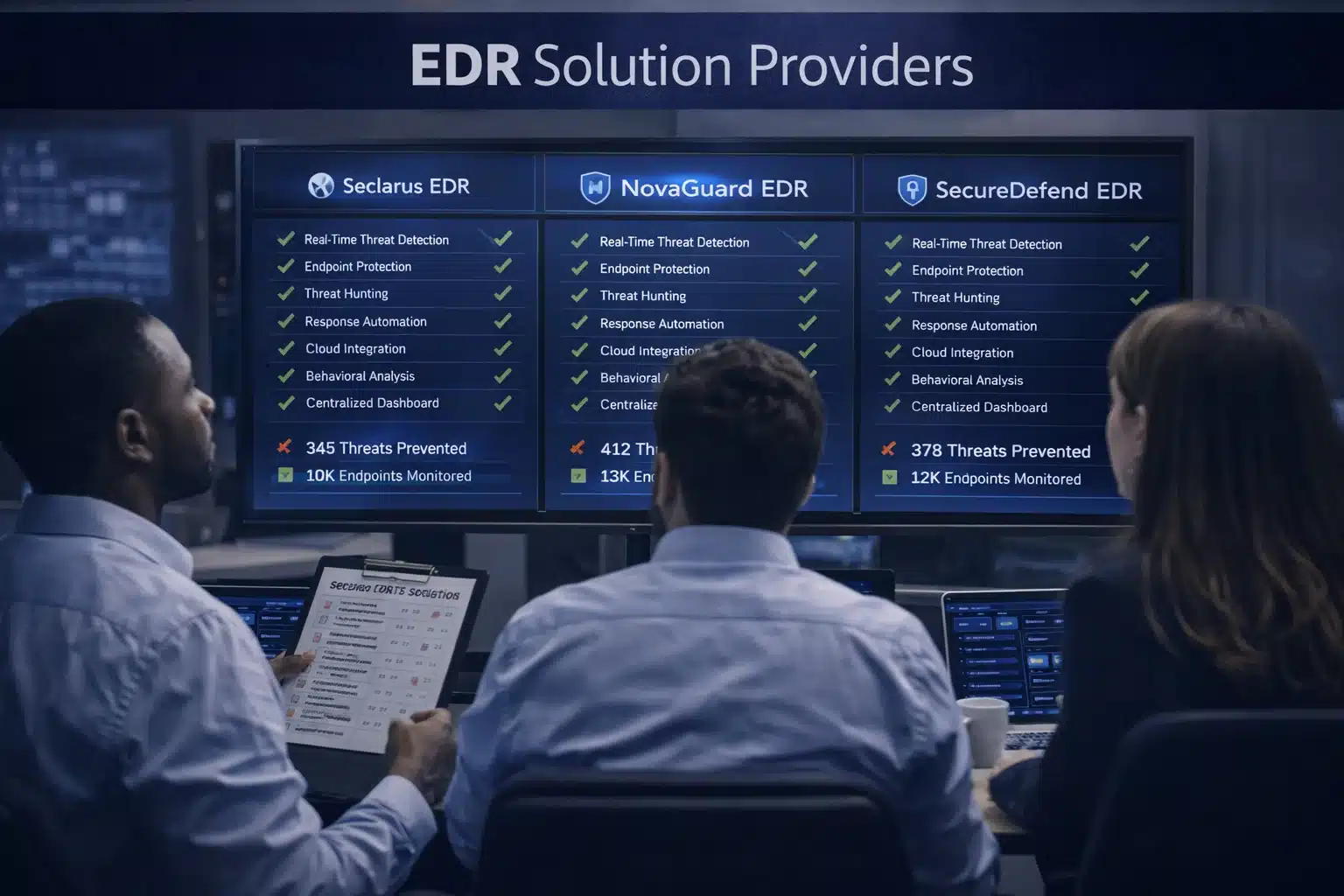
The expectations organizations bring to EDR solution providers have shifted considerably. A few years ago, behavioral detection and automated response were differentiators. In 2026, they are the baseline. What separates strong providers from the rest has moved up the value chain — into AI maturity, managed service depth, XDR convergence, and how effectively a provider reduces the operational burden on security teams rather than adding to it.
According to Mordor Intelligence, the global EDR market is projected to expand from USD 5.11 billion in 2025 to USD 18.68 billion by 2031, at a CAGR of 24.16%. That growth trajectory is being driven by ransomware sophistication, cloud-first infrastructure expansion, and the increasingly accepted reality that traditional endpoint protection cannot detect modern attack techniques on its own.
Here’s what organizations should actually expect from leading EDR solution providers heading into 2026 — and what questions to ask before committing to any of them.
Understanding where the floor sits helps clarify what genuine differentiation looks like. Any credible EDR solution provider in 2026 should deliver, without exception:
Providers that don’t deliver consistently on all of these are worth dismissing quickly. The evaluation time is better spent on factors that genuinely differ between strong candidates. For a detailed breakdown of what specific features to demand at each stage, ClearNetwork’s guide on endpoint detection and response vendors covers the evaluation framework in full.
Every EDR provider now claims AI-driven detection. The claims range from genuinely sophisticated models trained on billions of endpoint events to conventional rule engines with an AI label applied for marketing purposes. Knowing how to tell the difference is one of the most useful skills an evaluator can develop.
Real AI maturity in an EDR product shows up in a few specific ways. Detection models that adapt to your environment over time — tightening behavioral baselines as they learn what normal looks like for your specific user population and infrastructure — outperform models trained on generic threat data alone.
Providers that operate at massive scale, ingesting telemetry from thousands of customer environments, can surface novel attack patterns faster than those with narrower data sets.
The practical measure of AI maturity is alert quality. A platform generating high-volume, low-confidence alerts shifts the investigation burden onto your team, regardless of how advanced the underlying model is. The best EDR solution providers deliver alerts that are pre-triaged, enriched with context, and scored by confidence level — so analysts start investigations with the relevant information already assembled, not a raw event log to sort through.
Providers that offer a trial period or proof-of-concept deployment are worth prioritizing during evaluation, specifically so alert quality and false-positive rates can be measured in your actual environment before any contract is signed.
Self-managed EDR deployments require security personnel who can configure detection rules, tune alert thresholds, investigate incidents, and execute response playbooks — around the clock. For organizations without a fully staffed security operations center, that’s a capability gap that technology alone doesn’t close.
Managed EDR services address this by providing the analyst layer alongside the platform. The provider’s team monitors alerts, investigates incidents, contains threats, and provides post-incident reporting — while the client retains visibility into everything happening in their environment. This model has expanded the practical reach of enterprise-grade EDR to organizations that couldn’t otherwise sustain it.
Not every “managed” offering represents the same level of commitment. Before signing, organizations should verify:
ClearNetwork’s overview of managed EDR security services explains how the managed model works in practice and what organizations should expect from a provider handling endpoint security on their behalf.
The line between EDR and Extended Detection and Response (XDR) has blurred significantly. Most leading EDR solution providers now offer XDR capabilities — extending visibility from endpoints into network traffic, cloud workloads, and identity platforms — either natively or through integrations with their broader security stack.
For organizations evaluating providers in 2026, this convergence matters in a specific way. An EDR product evaluated in isolation may look equivalent to a competitor’s offering. Evaluated as a component of a broader detection and response architecture — alongside SIEM, threat intelligence, and network monitoring — the integration quality and data correlation depth between components can differ dramatically.
The providers building native XDR platforms rather than assembling them through third-party connectors tend to deliver better cross-signal correlation. That said, the best integration for any specific organization depends heavily on what security tools are already in place.
Grand View Research notes that cloud-based EDR deployment commanded a 54.8% market share, with the trend accelerating toward cloud-native architectures that support this cross-environment correlation more naturally than on-premise deployments.
For organizations still weighing whether modern EDR warrants replacing their existing toolset, ClearNetwork’s breakdown of EDR providers versus traditional security tools is a useful reference point.
Start by defining coverage requirements before reviewing vendors — cloud workloads, Linux servers, macOS endpoints, and mobile devices all have different telemetry characteristics, and a provider that excels at Windows coverage may have real gaps elsewhere.
From there, test detection against your actual threat profile rather than generic benchmarks: the relevant question is how a platform performs against the attack categories most likely to target your industry, not how it scores on standardized tests designed for someone else’s environment.
Integration depth deserves equal weight. EDR doesn’t operate in isolation — how well a provider connects with your SIEM, identity platform, and ticketing system determines how effectively endpoint intelligence reaches the rest of your security operations.
Providers with open APIs and pre-built integrations reduce deployment complexity and the ongoing maintenance overhead that custom connectors create. Contact ClearNetwork to discuss which EDR solution and service model fits your environment.
Not all EDR platforms are built the same, and the gap between CrowdStrike EDR and…
Any meaningful SIEM solutions comparison has to go beyond spec sheets. Feature parity across major…
Finding the right SIEM options for top security operations has never involved more variables. Cloud-native…
Choosing a SIEM platform has never been more complicated — or more consequential. The market…
The way organizations monitor their networks has changed more in the past three years than…
Security teams don't lose to attackers because they lack tools. They lose because they're reacting…