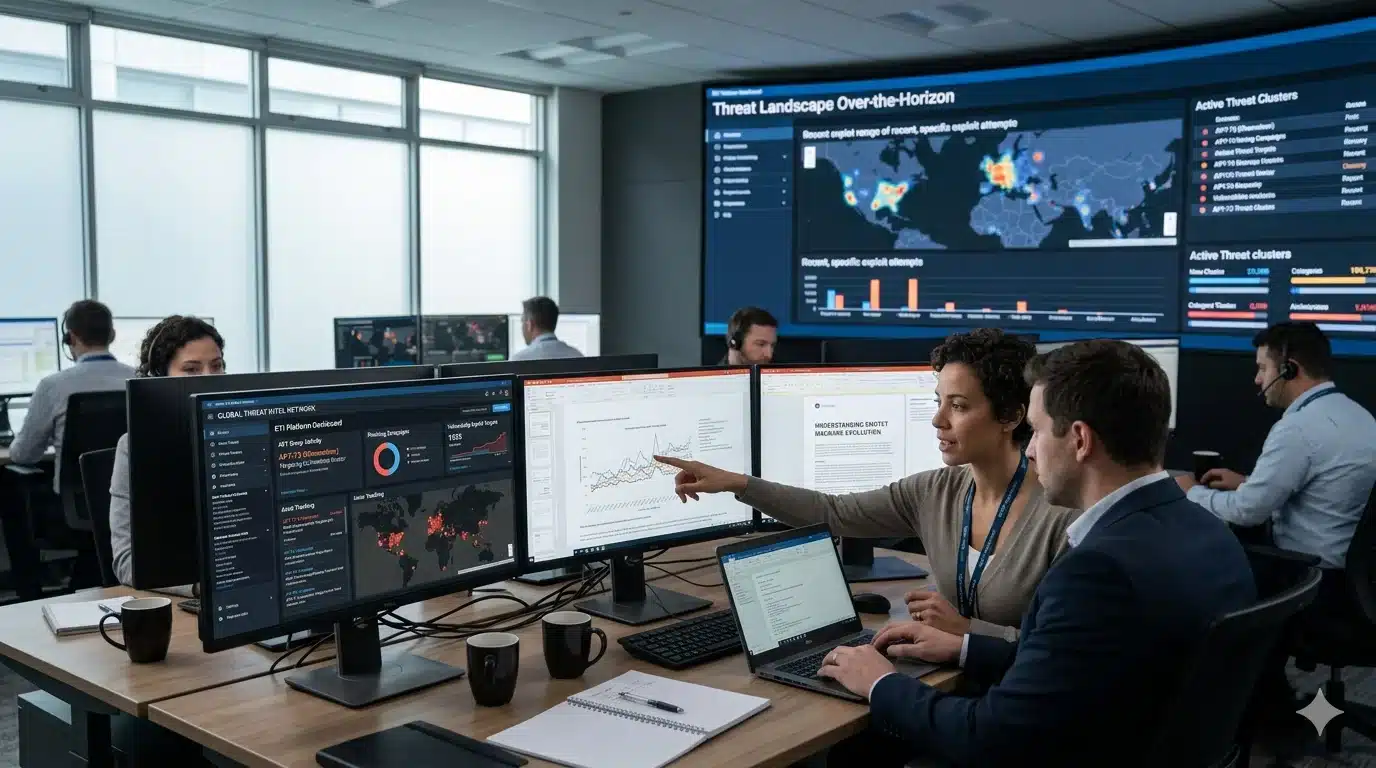
Security teams don’t lose to attackers because they lack tools. They lose because they’re reacting to threats that intelligence could have anticipated hours — or days — earlier. Cyber threat intelligence services change that equation by giving defenders the context they need to act before damage is done, not after.
Understanding what cyber threat intelligence actually is, how the tools behind it function, and why real-time intelligence has become central to modern security operations is the starting point for any organization serious about shifting from reactive defense to proactive protection.
Cyber threat intelligence — commonly abbreviated CTI — is the collection, analysis, and operationalization of information about potential and active threats to an organization’s systems and data. The keyword is actionable. Raw threat data isn’t intelligence; it only becomes intelligence when it’s been processed, contextualized, and applied to a specific decision or defensive action.
CTI covers a broad spectrum:
Most organizations need all four types working together. Strategic intelligence without tactical context produces high-level reports that don’t translate into better defenses. Technical intelligence without strategic framing generates noise that overwhelms analysts without clarifying which threats actually matter for a specific environment.
The threat landscape has compressed the time window defenders have to respond. According to Mandiant’s M-Trends 2025 report, the global median dwell time — the period between initial compromise and detection — was 11 days in 2024. That’s 11 days during which an attacker can establish persistence, move laterally, exfiltrate data, or prepare a ransomware deployment before anyone raises an alarm.
Real-time cyber threat intelligence services close this window in two ways: first, by feeding live IOCs and threat actor activity data directly into detection systems, so that known malicious infrastructure is flagged the moment it’s contacted. Second, it gives analysts the context to recognize subtle behavioral signals that would otherwise blend into normal traffic patterns.
The financial stakes reinforce the urgency. Threat intelligence spending reflects an industry that has run the cost-benefit math: the Mordor Intelligence threat intelligence market report valued the global market at USD 9.21 billion in 2025 and projects growth to USD 16.90 billion by 2030, at a CAGR of 12.92%. Organizations aren’t spending at that scale out of enthusiasm for the technology — they’re spending because the cost of operating without it has become demonstrably higher.
The mechanics of CTI services vary by provider, but the core workflow follows a consistent pattern: collect, process, analyze, disseminate, act.
Effective cyber threat intelligence tools pull from multiple source categories simultaneously:
No single source is sufficient. A threat feed that covers known malware hashes misses novel variants. Internal telemetry that isn’t correlated against external intelligence fails to recognize attacker infrastructure.
The value of a managed CTI service lies in aggregating and correlating across all of these simultaneously. You can explore how ClearNetwork integrates threat intelligence into active security operations through its SOC threat intelligence capabilities.
Raw data collected from these sources has to be structured, deduplicated, and enriched before it’s useful. This is where cyber threat intelligence tools apply machine learning and automated analysis to sort signal from noise — scoring indicators by confidence level, mapping TTPs to the MITRE ATT&CK framework, and connecting new IOCs to known threat actor groups.
For security teams, this enrichment step is what separates a list of IP addresses from a picture of who’s attacking, why, and how. An IP address alone tells you little. That same IP address correlated to an active ransomware campaign targeting healthcare organizations tells an analyst exactly how seriously to treat the alert.
Intelligence has no operational value sitting in a report. The best cyber threat intelligence services integrate directly with the security controls that need to act on that information — SIEM platforms, EDR tools, firewalls, and identity systems. When a new malicious domain is identified, it should automatically appear as a blocked destination and a detection rule, not just in a briefing document.
This integration layer is where many organizations stumble. A CTI platform that delivers excellent intelligence but doesn’t connect to operational security tools still requires analysts to manually translate intelligence into defensive actions — a process that introduces delays and human error at exactly the moment speed matters most.
For organizations evaluating how intelligence feeds into broader monitoring workflows, ClearNetwork’s breakdown of SIEM and log management integration covers how these systems work together in practice.
Real-time threat detection without intelligence context is pattern recognition. It catches anomalies — a user logging in at an unusual hour, an endpoint communicating with an unfamiliar address — but can’t distinguish a genuine attack from a legitimate deviation without additional context.
Cyber threat intelligence services add that context in real time:
| Detection Scenario | Without CTI | With CTI |
| Endpoint contacts an unknown IP | Alert generated, analyst investigates manually | IP cross-referenced against live threat feeds; classified as C2 infrastructure in seconds |
| User account shows unusual login pattern | Flagged as an anomaly, low priority | Correlated with a credential theft campaign active in the sector; escalated immediately |
| New file hash observed on the network | Scanned by signature tools, no match | Matched against behavioral threat profile; identified as a novel variant of a known ransomware family |
| Lateral movement between systems | Detected as a policy violation | Mapped to TTPs associated with a specific threat actor group; response playbook activated |
The difference isn’t just speed — it’s the quality of the response. An analyst who knows they’re looking at infrastructure associated with a specific ransomware group responds differently than one investigating an unknown anomaly. They know what persistence mechanisms to look for, what data the attacker is likely targeting, and what containment actions to prioritize.
The market for cyber threat intelligence tools has expanded significantly, which means the quality variance between platforms is substantial. Evaluating them requires looking beyond feature lists.
For organizations exploring what a structured approach to real-time detection looks like, ClearNetwork’s overview of managed detection and response services explains how continuous intelligence feeds into 24/7 security operations.
The case for cyber threat intelligence services isn’t theoretical. It’s built on the observable gap between organizations that can contextualize threats in real time and those that discover incidents through user reports or downstream data loss.
Closing that gap starts with an honest assessment: where does your current security stack lack context? Where are analysts spending investigation time that better intelligence could compress? Which threat categories — ransomware, supply chain attacks, credential theft — are most relevant to your industry and most underserved by your current detection coverage?
Those answers point directly to what effective CTI integration should prioritize. For organizations ready to explore what managed cyber threat intelligence services look like when embedded into a full security operations model, ClearNetwork’s team can walk through the options specific to your environment and threat profile.
Finding the right SIEM options for top security operations has never involved more variables. Cloud-native…
Choosing a SIEM platform has never been more complicated — or more consequential. The market…
The way organizations monitor their networks has changed more in the past three years than…
Running a Security Operations Center in-house has always been expensive. Staffing it around the clock,…
Endpoint security is no longer optional—it's the front line of every serious cybersecurity posture. As…
The role of a Security Information and Event Management (SIEM) system has shifted from being…