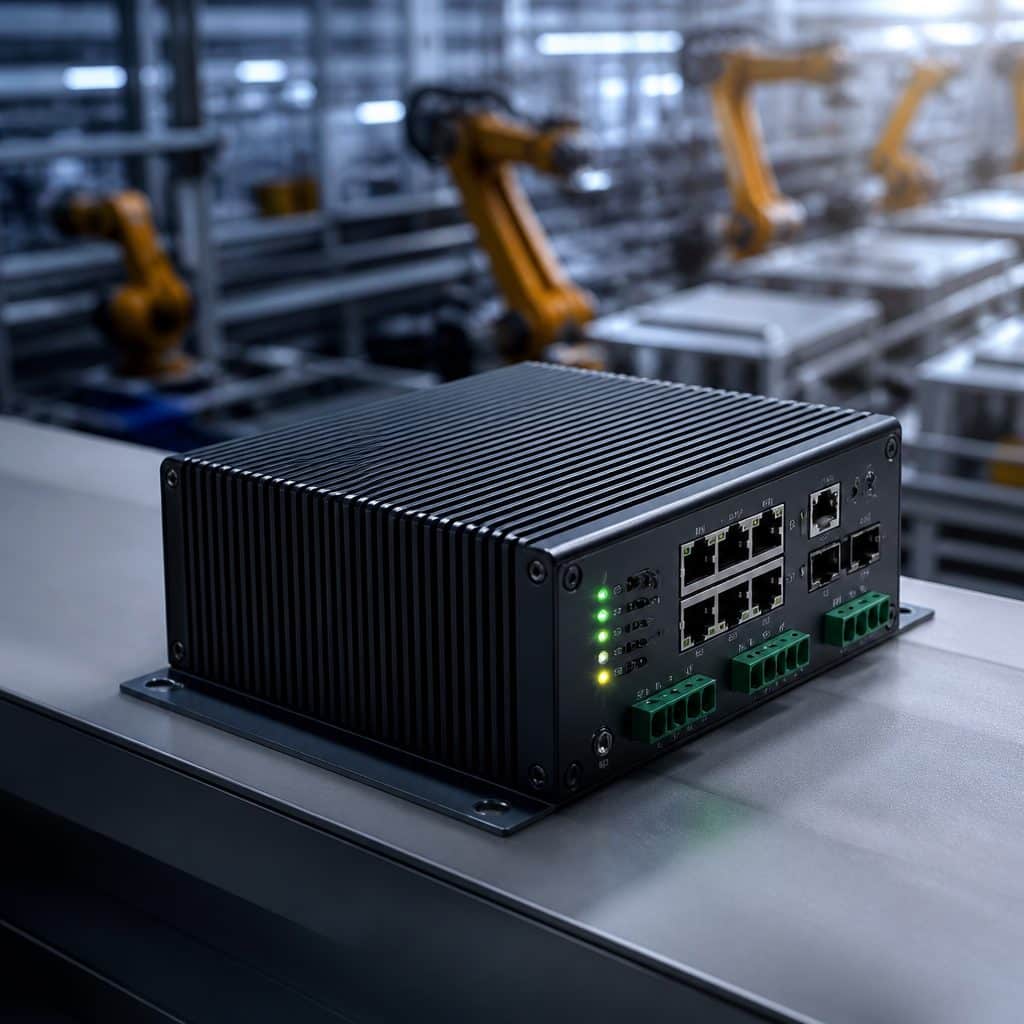
Manufacturers cannot protect operational technology (OT) the same way they protect office IT. A plant network contains assets that may be decades old, run proprietary protocols, and control machinery where a delayed command, unexpected reboot, or blocked packet can create safety, quality, and revenue consequences. The security objective is not simply to find every vulnerability. It is to reduce cyber risk while preserving deterministic operations, maintenance windows, and production targets.
That distinction matters as attackers increasingly target industrial environments. The IBM Cost of a Data Breach Report has consistently found that industrial organizations face substantial breach costs, while ransomware incidents can introduce losses that extend beyond recovery work into missed shipments, product spoilage, contract penalties, and reputational damage. For plant leaders, security monitoring must therefore be operationally aware: accurate enough to identify real threats, passive enough to avoid interrupting production, and actionable enough to support a fast, coordinated response.
Traditional IT monitoring assumes that endpoints can be scanned, agents can be deployed, patches can be applied quickly, and suspicious systems can be isolated with limited business impact. Those assumptions often fail on the plant floor. Programmable logic controllers, human-machine interfaces, engineering workstations, industrial control servers, sensors, drives, and safety systems have different availability, safety, and vendor-support requirements.
Many manufacturing environments also operate as a connected ecosystem rather than a single network. Corporate IT, remote maintenance platforms, production scheduling systems, historians, warehouse automation, quality systems, and third-party vendors may all exchange data with OT. Each connection can create a path for a threat actor or an accidental configuration change to reach sensitive equipment.
The first practical step is building an accurate OT asset inventory. Many plants rely on spreadsheets, engineering drawings, or tribal knowledge that quickly become outdated. A modern monitoring program uses passive network sensors, traffic analysis, firewall telemetry, switch data, and approved management interfaces to identify devices and communications without actively probing fragile assets.
Passive discovery helps teams answer questions that frequently delay incident response: Which systems are communicating across zones? Which engineering workstation can program a controller? Which assets still use default protocols or unsupported operating systems? Are remote vendors accessing the network through approved jump hosts, or directly through unmanaged connections?
Visibility is not merely a compliance exercise. It establishes a baseline for normal operations. Once monitoring understands routine communication patterns, it can identify deviations such as a workstation initiating a new protocol, a controller communicating with an unfamiliar host, a sudden increase in failed authentication attempts, or an engineering tool connecting outside its normal maintenance period.
| Monitoring priority | What to establish | Business value |
|---|---|---|
| Asset inventory | Device role, owner, firmware, zone, and criticality | Faster risk decisions and recovery planning |
| Communication baseline | Expected protocols, peers, and traffic timing | More reliable anomaly detection |
| Remote access | Approved paths, identities, and session timing | Lower third-party access risk |
OT incidents rarely begin with a dramatic attack on a controller. More often, attackers exploit the connections between IT and OT: phishing that compromises an employee account, stolen remote-access credentials, an exposed VPN appliance, a vulnerable server, or unmanaged vendor access. From there, they move laterally toward systems that can influence production.
Monitoring should therefore cover the convergence points, not only the plant network itself. This includes internet-facing infrastructure, identity systems, remote-access gateways, firewalls between zones, engineering workstations, Windows servers supporting production, backup systems, and cloud services that exchange manufacturing data.
The Cybersecurity and Infrastructure Security Agency recommends applying defense-in-depth practices to industrial control systems, including segmentation, logging, secure remote access, and incident response planning. The NIST Guide to Operational Technology Security similarly emphasizes that OT security decisions must account for safety, reliability, and performance requirements.
A useful monitoring architecture combines OT network telemetry with IT security events. Correlating both data sets can reveal a complete attack path: an unusual sign-in, followed by a remote desktop session, followed by access to an engineering workstation, followed by new traffic to a controller subnet. Without correlation, each event may appear harmless in isolation.
Manufacturers should not measure success by the number of alerts generated. A noisy monitoring platform can overwhelm lean OT and IT teams, causing real threats to be missed. The better approach is to define a small, prioritized set of detection use cases tied to credible operational scenarios.
Detect logins outside approved windows, impossible travel, new privileged accounts, or vendor sessions that bypass the designated jump host.
Investigate new administrative connections between IT and OT zones, credential dumping behavior, and unexpected access to critical servers.
Flag changes to controller logic, firmware, configurations, or safety-related settings that lack an approved maintenance record.
Additional high-value use cases include ransomware indicators on Windows-based plant assets, disabled security controls, new unmanaged devices, DNS requests to known malicious infrastructure, suspicious data transfer from historians, and configuration changes to industrial firewalls. Each use case should name the asset owner, required evidence, escalation route, and safe response options.
Detection alone does not stop an incident. If a compromised business workstation can freely reach an entire production network, responders face an impossible choice: accept the risk or disconnect broad areas of the plant. Segmentation makes more precise response possible by dividing networks into zones based on function, criticality, and communication need.
A practical architecture commonly separates enterprise IT, industrial demilitarized zones, site operations, cell or area zones, and safety-related systems. Firewalls and access controls enforce only the communications that are required for the process. Monitoring then verifies whether those rules are working as intended and highlights unauthorized pathways.
Segmentation projects should be phased carefully. Start by mapping traffic, documenting dependencies, and validating rules in observation mode. Work with controls engineers, production leaders, network teams, and equipment vendors before enforcing changes. A rule that appears unnecessary in a diagram may support a monthly maintenance task, a quality inspection station, or a recovery procedure.
This is where experienced Managed SOC Services can add value. A SOC team can correlate firewall, identity, endpoint, and OT alerts continuously, while escalation workflows ensure plant stakeholders retain authority over actions that could affect production.
Manufacturers evaluating OT monitoring platforms should look beyond a feature checklist. Protocol coverage matters, but so do deployment flexibility, passive collection methods, asset classification accuracy, integration with existing security tools, data retention, reporting, and the provider’s ability to support incident investigation.
Ask vendors and managed service providers direct operational questions. Can sensors operate without active scanning? How are false positives tuned during production cycles? Can analysts distinguish a planned engineering change from suspicious activity? What happens after a high-confidence alert at 2:00 a.m.? Who contacts the plant, and what evidence will they provide before recommending containment?
Endpoint coverage remains important for Windows-based engineering stations, servers, and jump hosts. These systems are frequent targets because they bridge user activity and industrial operations. Where endpoint agents are supported, organizations can pair OT visibility with managed CrowdStrike monitoring to investigate endpoint behavior, identity misuse, and ransomware activity alongside network events.
Likewise, a SIEM should not become a log warehouse with no operational outcome. It should normalize the right sources, correlate meaningful events, retain evidence for investigations, and support reporting that plant and executive stakeholders can understand. The goal is fewer, better decisions—not more dashboards.
OT incident response must be rehearsed before an emergency. A corporate incident playbook that says “isolate the host immediately” may be unsafe when the host supports a batch process, controls material movement, or manages environmental conditions. Response plans need predefined decision points that balance cyber containment with safety and continuity.
For each critical scenario, define who can authorize action, who contacts the equipment vendor, how evidence is preserved, which connections can be restricted safely, and how the production team will be informed. Include alternatives to full isolation, such as disabling a remote-access account, blocking a malicious external destination, limiting an affected zone, or moving operations to a documented manual procedure.
Tabletop exercises are particularly valuable. Walk through a realistic scenario involving ransomware on an engineering workstation or unauthorized remote access to a production cell. Identify where asset ownership is unclear, where communications would stall, and where the business lacks a tested fallback. Those findings often deliver more value than another generic vulnerability report.
For organizations without around-the-clock analysts, Managed Detection and Response can provide continuous alert investigation and escalation. The key requirement is an MDR operating model that understands which actions can be taken immediately and which require plant approval.
Clearnetwork helps manufacturers assess, monitor, tune, investigate, and respond across OT, IT, endpoint, network, and security operations programs. Build a practical roadmap around the realities of your plant.
It should not when designed correctly. Passive network monitoring observes traffic through network taps, span ports, or approved collectors rather than sending probes to controllers. Any active assessment, agent deployment, firewall change, or containment action should follow plant change-control procedures and be validated with operations and equipment vendors.
Begin with critical assets, IT-to-OT connections, remote access, engineering workstations, industrial firewalls, and systems that support safety, quality, or production scheduling. Prioritizing high-consequence pathways creates meaningful risk reduction faster than attempting to monitor every device equally on day one.
OT cybersecurity requires shared ownership. Operations understands process impact; engineering understands control systems; IT understands enterprise infrastructure; security teams bring detection and response expertise. Executive sponsorship is necessary to resolve priorities, fund improvements, and ensure that security decisions support production rather than compete with it.
Useful metrics include the percentage of critical assets inventoried, monitored, segmented, and covered by tested response procedures; the number of unauthorized pathways removed; alert investigation time; remote-access compliance; and the time required to validate a potentially disruptive security event. Progress should be reported in operational terms, not only technical counts.
Effective OT security monitoring is a business resilience program. It gives manufacturers the visibility to identify threats early, the context to avoid unnecessary disruption, and the response discipline to protect people, equipment, and delivery commitments. The strongest programs bring security operations and plant operations together, using continuous monitoring to make safer, faster decisions when it matters most.
Turn PCI DSS 4.0.1 monitoring into faster payment threat response—master Requirements 10, 11 and 12,…
Contain a Microsoft 365 BEC in 24 hours: revoke sessions, preserve evidence, stop payment fraud,…
Make SIEM costs predictable with a 4-layer TCO model covering licensing, data ingestion, security operations…
Turn CrowdStrike Falcon into 24/7 protection with expert triage, threat hunting, policy tuning and rapid…
Turn CMMC 2.0’s 110 requirements into audit-ready proof with continuous monitoring, alert reviews, remediation records,…
Verify true 24/7 SOC response with 12 essential checks—from overnight staffing to preauthorized containment—to separate…