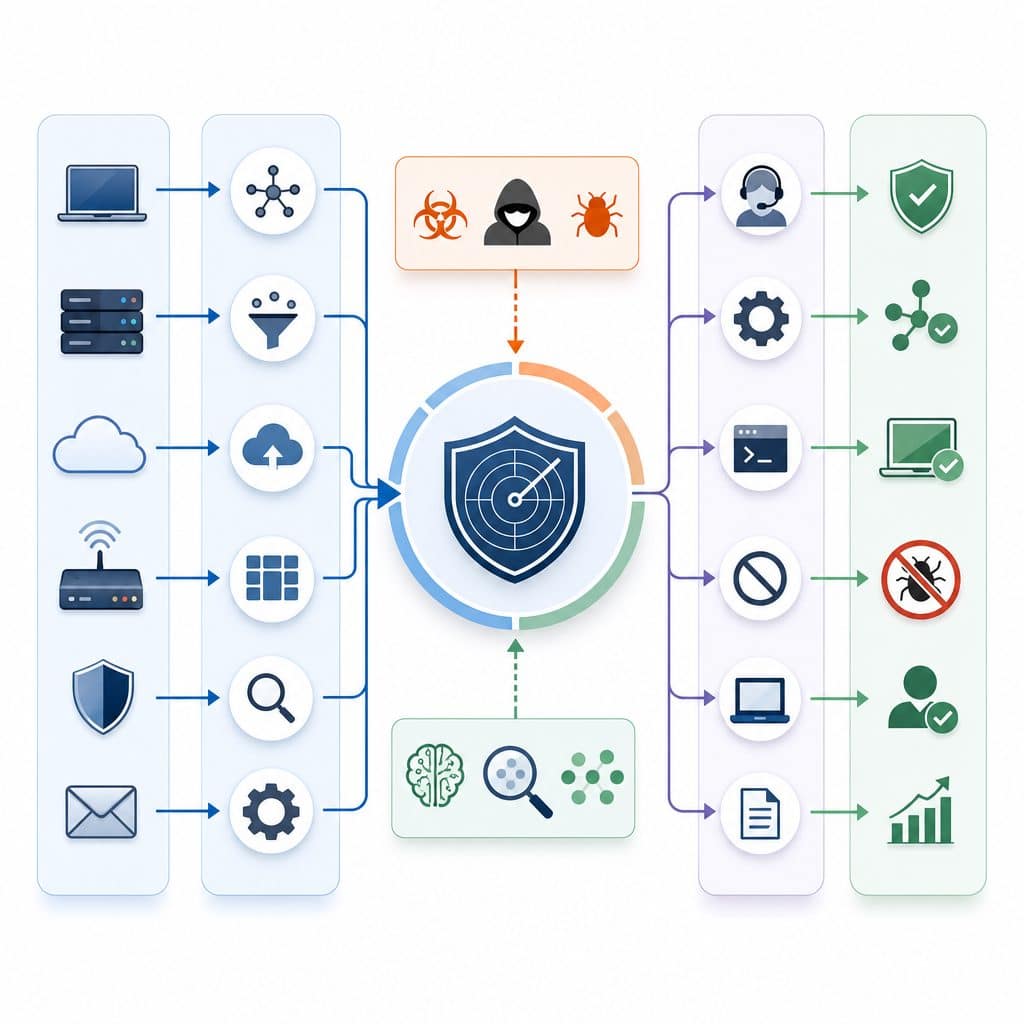
MDR services give organizations a way to improve threat detection, investigation, and response without building a full security operations center from scratch. The business case is not simply “more monitoring.” It is reducing the time between attacker activity and confident containment, while making better use of the security tools you already own.
For many midmarket and enterprise teams, the hard problem is operational. EDR alerts arrive at 2 a.m. Cloud identity logs are noisy. SIEM correlation rules age quickly. Vulnerability, email, endpoint, and network tools all produce evidence, but few teams have enough analysts to connect it continuously. A mature MDR provider turns that telemetry into decisions: what happened, how serious it is, what to do now, and how to prevent repeat exposure.
Clearnetwork provides MDR services as part of a broader managed security services model. We help clients operate, monitor, tune, investigate, and respond across endpoint, SIEM, cloud, network, and program controls, so security becomes a daily operating capability rather than a collection of underused licenses.
Managed Detection and Response combines technology monitoring with human analysis and response execution. Buyers sometimes assume MDR is an EDR add-on, but strong services are broader. The provider should understand attacker behavior, normalize signals across tools, validate alerts, preserve evidence, coordinate containment, and explain risk in language executives can act on.
In practice, MDR should include:
The best MDR relationships are collaborative. Your provider should not disappear behind a portal. They should meet regularly, review detection quality, escalate urgent issues clearly, document actions, and help your team mature controls over time.
Security leaders are under pressure from three directions: more aggressive adversaries, expanding attack surfaces, and constrained talent. Verizon’s 2024 Data Breach Investigations Report found that exploitation of vulnerabilities as an initial access action nearly tripled year over year, driven heavily by edge device and software flaws. IBM’s 2024 Cost of a Data Breach Report put the global average breach cost at 4.88 million dollars, the highest in that study’s history. Mandiant’s M-Trends reporting continues to show that faster discovery changes outcomes, especially when attackers move from initial access to privilege escalation quickly.
These statistics matter because they expose a gap between tool deployment and operational readiness. A company may own premium endpoint protection, a SIEM, vulnerability scanners, and cloud logging, yet still lack continuous monitoring, response authority, and detection content aligned to its real risks. MDR services address that gap by putting accountable people and process around the stack.
The market uses overlapping terms, which can make sourcing difficult. MDR emphasizes active threat detection and response. Managed SOC Services emphasize outsourced security operations, including monitoring, triage, escalation, reporting, and sometimes compliance support. SOC as a Service usually describes a more complete outsourced SOC capability, often centered on 24/7 coverage, SIEM operations, and analyst workflows.
In real environments, the boundaries are less important than accountability. Ask what the provider will actually do when an alert fires, a privileged account behaves unusually, or ransomware indicators appear on an endpoint. A useful service description names tools, hours, escalation paths, response actions, reporting cadence, and exclusions.
| Capability | Primary focus | Buyer question |
|---|---|---|
| MDR | Threat detection, investigation, and containment | Will analysts validate and respond to active attacks? |
| Managed SOC | Continuous monitoring, triage, and operational reporting | Who watches our environment and manages alerts? |
| SOCaaS | Outsourced SOC operating model | Can we buy SOC coverage instead of building one? |
Clearnetwork can support these models independently or together, depending on existing investments, compliance drivers, staffing, and risk tolerance.
MDR is most valuable where response speed and operational consistency determine business impact. That includes organizations with regulated data, distributed users, hybrid infrastructure, lean IT teams, or a history of alert fatigue. It is also useful after major technology investments, when leadership expects measurable security improvement but the team needs help tuning and running the platform.
MDR helps identify credential abuse, lateral movement, suspicious PowerShell, mass file changes, and command-and-control behavior before encryption spreads.
For teams using EDR, managed endpoint monitoring reduces missed alerts and accelerates containment. Clearnetwork also offers Managed CrowdStrike support for Falcon environments.
MDR becomes stronger when endpoint evidence is correlated with identity, firewall, cloud, and application logs through reliable SIEM monitoring.
Clear escalation and post-incident reporting help leaders understand exposure, actions taken, residual risk, and investment priorities.
A mature provider runs MDR like an operating system, not a help desk queue. The work starts with onboarding and baselining. Analysts need asset context, business criticality, known administrative tools, VIP users, third-party access paths, and approved maintenance windows. Without that context, even skilled analysts waste time chasing expected activity or miss the significance of a subtle event.
After onboarding, operations should follow a disciplined cycle:
This cycle is where many internal programs stall. Detection content grows stale, exception lists expand, and response tasks remain informal. Clearnetwork’s role is to keep the program moving: operate the controls, monitor the signals, tune the noise, investigate suspicious behavior, and coordinate response.
The right MDR partner depends on your risk profile and operating model. A low-cost alert forwarding service may be acceptable for a small environment with basic needs. A regulated enterprise, acquisition target, or ransomware-sensitive manufacturer usually needs deeper investigation, stronger response authority, and clearer governance.
Use these questions during evaluation:
| Criterion | What to ask | Why it matters |
|---|---|---|
| Coverage | Which hours, tools, locations, and severity levels are included? | Avoids assumptions during urgent events. |
| Response authority | Can the provider isolate hosts, disable accounts, or block indicators? | Determines whether MDR can reduce dwell time. |
| Detection quality | How are rules created, tested, retired, and mapped to ATT&CK? | Prevents noisy monitoring from replacing useful detection. |
| Evidence handling | Are timelines, logs, and analyst notes preserved for audit or insurance? | Supports compliance, claims, and lessons learned. |
| Governance | How often are service reviews, metrics, and roadmap discussions held? | Keeps MDR aligned with business risk. |
Also ask about what is excluded. Some providers monitor only their preferred EDR. Others will not touch firewall rules, identity controls, or cloud consoles. Exclusions are not necessarily bad, but hidden exclusions create risk during incidents.
MDR depends on visibility. If critical telemetry is missing, analysts will see fragments instead of incidents. Endpoint data is often the starting point because ransomware, malware, and hands-on-keyboard activity usually leave host evidence. Identity data is equally important because attackers increasingly use valid credentials. SIEM and log management add context from firewalls, VPNs, SaaS applications, cloud control planes, and business systems.
Clearnetwork works with client-owned technologies and helps make them operationally useful. That may include endpoint policy tuning, SIEM monitoring, correlation logic, escalation playbooks, and reporting. For organizations using AlienVault, Clearnetwork can provide managed AlienVault support that strengthens SIEM operations and compliance visibility.
The tradeoff is scope. More data sources can improve detection, but they also add cost, complexity, and tuning demands. A practical MDR roadmap starts with high-value telemetry, validates use cases, then expands where the additional signal changes response decisions.
MDR reporting should help leaders understand performance, not drown them in activity counts. Volume alone is misleading; a lower alert count may mean better tuning or worse visibility. Useful metrics connect operations to risk reduction.
NIST’s Cybersecurity Framework 2.0 reinforces this operational view by connecting identify, protect, detect, respond, recover, and govern functions. MDR contributes most directly to detect and respond, but mature service reviews should also influence protection priorities and governance decisions.
The first pitfall is buying MDR as an insurance checkbox. Cyber insurers, auditors, and boards may ask about monitoring, but a service purchased only for evidence rarely changes outcomes. The provider must be integrated into real response processes.
The second pitfall is unclear ownership. If Clearnetwork recommends isolating a server, who approves it? If an executive account is compromised, who contacts legal, HR, and communications? MDR works best when decision rights are agreed before the incident.
The third pitfall is tool sprawl. Adding another portal without rationalizing alerts can increase analyst burden. A good provider helps simplify operations by tuning detections, consolidating evidence, and showing which tools are delivering value.
Finally, do not confuse speed with recklessness. Aggressive automated containment can disrupt production if business context is missing. MDR should balance urgency with approved playbooks, asset criticality, and escalation discipline.
Clearnetwork’s MDR approach is grounded in managed security operations experience. We do not treat detection as a one-time configuration exercise. We help clients define coverage, connect telemetry, tune controls, investigate alerts, execute or coordinate response, and improve the program through recurring reviews.
That operating model is especially useful for organizations that have invested in strong platforms but need help extracting value from them. Instead of forcing a rip-and-replace, Clearnetwork assesses what is already deployed, identifies blind spots, and builds a practical path toward better monitoring and response.
Typical engagement outcomes include cleaner alert queues, faster escalations, better endpoint coverage, more useful SIEM content, documented response playbooks, clearer executive reporting, and fewer surprises during audits or incidents.
No. Incident response is usually activated after a suspected or confirmed event. MDR is continuous monitoring, investigation, and response support designed to find and contain threats earlier. Strong MDR programs also make formal incident response faster because evidence and escalation paths are already organized.
Yes. MDR reduces operational burden, but your team still owns business context, risk acceptance, and final authority for disruptive actions. The best model pairs provider expertise with internal knowledge of systems, users, and priorities.
Initial value often appears during onboarding, when coverage gaps, noisy rules, and unclear response steps become visible. Measurable improvement depends on telemetry quality, approval workflows, and how quickly recommended tuning is implemented.
If your team needs practical MDR services, managed security monitoring, or help operating the tools already in place, talk to Clearnetwork. We can assess your environment, define the right service scope, and build a response model that fits your business. The goal is straightforward: better visibility, faster decisions, cleaner operations, and less uncertainty when a real attacker tests your defenses after hours. Start with a focused conversation and measurable next steps.
Cut EDR alert fatigue without creating blind spots. Learn to prioritize high-risk signals, automate enrichment,…
Secure third-party remote access with MFA, accountable owners and complete visibility—critical as vendors feature in…
Turn PCI DSS 4.0.1 monitoring into faster payment threat response—master Requirements 10, 11 and 12,…
Protect plant uptime with passive OT security monitoring. Map legacy assets, baseline traffic, and detect…
Contain a Microsoft 365 BEC in 24 hours: revoke sessions, preserve evidence, stop payment fraud,…
Make SIEM costs predictable with a 4-layer TCO model covering licensing, data ingestion, security operations…