Managed detection and response is no longer a large-enterprise luxury. For many small and midsize businesses, MDR is the practical way to gain continuous threat monitoring, investigation depth, and response coordination without building a full security operations center. The right provider reduces dwell time, improves signal quality, and gives lean IT teams defensible evidence when executives, insurers, or regulators ask what happened.
The challenge is choice. SMB buyers face a crowded market of MDR providers, managed EDR vendors, MSSPs, cloud specialists, and platform companies that use similar language while delivering very different operating models. Some excel at endpoint containment but struggle with identity telemetry. Others provide strong alert triage but expect your staff to run remediation. A few, including experienced MSSPs such as Clearnetwork, focus on operating the whole security program around MDR, not just forwarding tickets.
Best is contextual. A five-person software company, a regional bank, and a manufacturer with aging operational technology do not need the same coverage. The strongest MDR provider for an SMB is the one that maps detection and response to business risk, available staff, compliance commitments, and technology already deployed. That means evaluating outcomes instead of buying the longest feature list.
A practical definition starts with four questions: what telemetry will be monitored, who investigates suspicious activity, how quickly can action be taken, and how the service improves over time. If a provider cannot answer those questions with specific workflows, escalation paths, reporting examples, and tuning responsibilities, the service may become another noisy tool rather than a managed outcome.
There is no universal ranking that fits every SMB. Still, several provider categories consistently appear in shortlists, and each has a different tradeoff profile. Use the categories below to narrow your options before comparing contracts.
| Category | Capabilities | Best fit | Watchouts |
|---|---|---|---|
| Managed security services providers | Broader technology operation, monitoring, investigation, response, and advisory support | SMBs wanting an outsourced security operating partner | Quality varies; validate depth, process, and accountability |
| Endpoint-native MDR providers | Strong EDR telemetry, rapid host isolation, malware expertise | Companies standardizing on one endpoint platform | Coverage may be narrow outside endpoints |
| Cloud or identity focused MDR | Deep SaaS, IAM, and cloud control monitoring | Cloud-first businesses with limited infrastructure | Endpoint, network, or legacy systems may need add-ons |
| Platform marketplace MDR | Provider service attached to a SIEM, XDR, or SASE platform | Teams already committed to that stack | Service flexibility can depend on product roadmap |
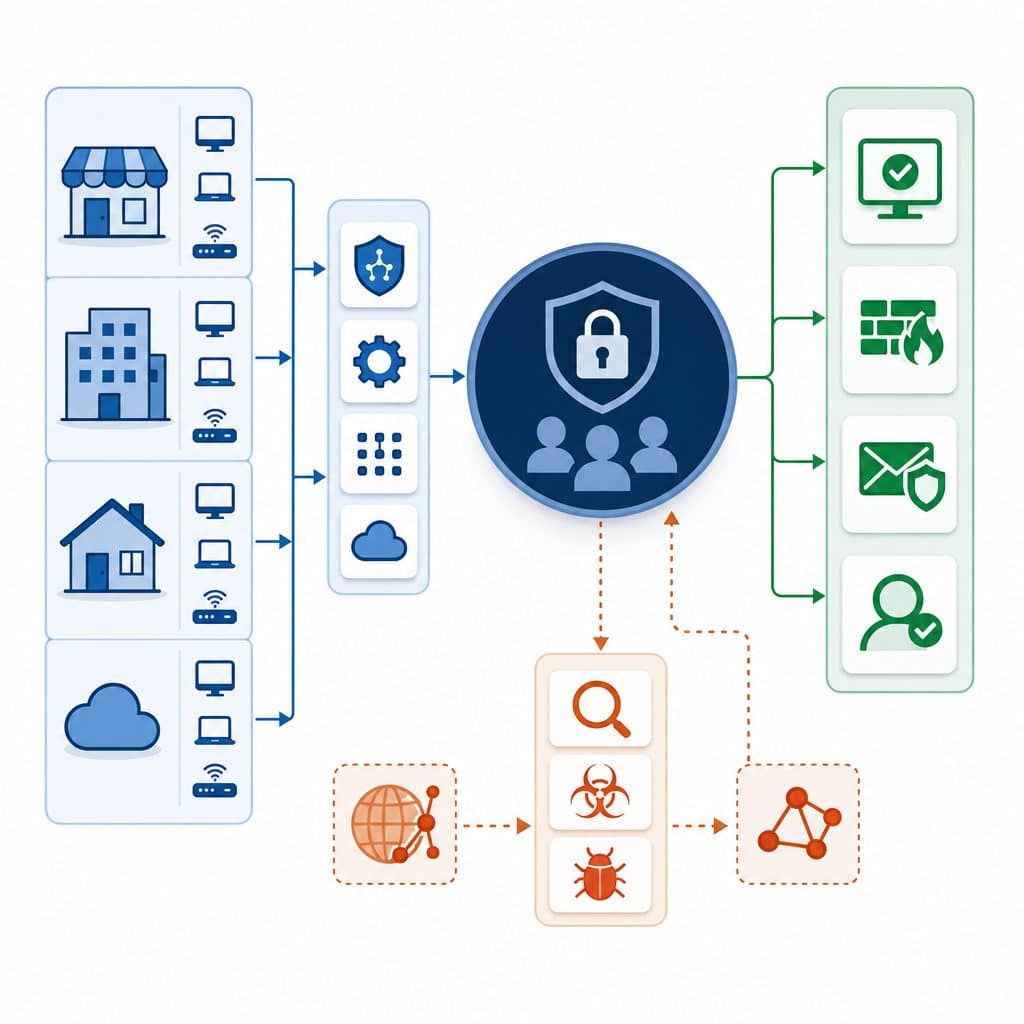
For many SMBs, an MSSP-led MDR model is the most flexible because it can integrate endpoint, firewall, identity, email, cloud, vulnerability, and ticketing data across vendors. Clearnetwork’s strength is helping clients operate and tune those technologies while providing monitoring and response guidance, so MDR becomes part of daily security operations rather than a disconnected subscription.
Buyers often start with promised response times, artificial intelligence claims, or analyst headcount. Those details matter, but they do not predict whether the provider will protect your business. Strong evaluation should dig into operating mechanics.
Ask each provider to walk through a recent anonymized investigation from first alert to closure. You should see how analysts handle uncertainty, how they decide severity, and what evidence reaches your team. Vague screenshots and generic sample reports are not enough.
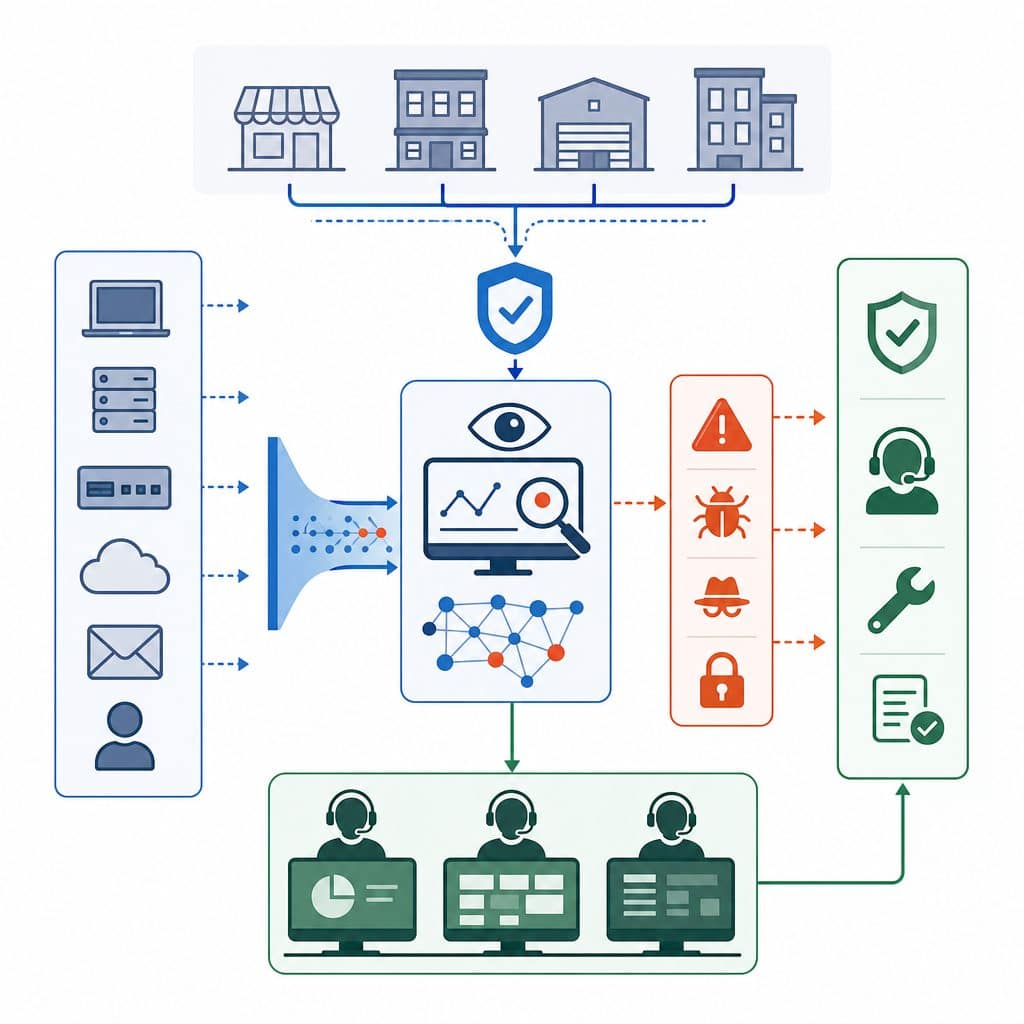
Good MDR is not a black box. It has a rhythm: onboarding, baseline tuning, live monitoring, incident collaboration, and continuous improvement. During onboarding, the provider should validate log sources, asset criticality, privileged accounts, escalation contacts, and response approvals. That foundation prevents confusion when suspicious behavior appears after hours.
During steady state, analysts should distinguish benign administration from malicious activity in your environment. That requires context about normal software deployment, remote access tools, executive travel, finance workflows, and third-party administrators. MDR providers that skip context gathering tend to escalate more false positives and miss business nuance.
During an incident, speed matters, but coordination matters more. An SMB cannot afford ten people debating whether a laptop can be isolated. Mature providers define decision rights in advance, document actions taken, and help your team communicate facts to leadership, legal, insurance contacts, and affected vendors.
Clearnetwork approaches MDR as a managed security operating model, not a standalone alerting service. Many SMBs already own useful controls, yet those controls are underconfigured, inconsistently monitored, or disconnected from response processes. The gap is rarely another dashboard. It is experienced people who can run the environment, interpret signals, and keep improving coverage.
That matters because SMB security teams are often hybrid by necessity. The same staff may manage Microsoft 365, endpoint agents, firewalls, backups, users, and compliance evidence. Clearnetwork helps extend that team with operational monitoring, tuning, investigation, and response support across cybersecurity technologies and programs. The result is better control use, faster decisions, and fewer unresolved findings.
Use procurement to uncover service reality. The best answers are specific, measurable, and tied to your environment. If responses sound interchangeable, the delivery may be interchangeable too.
These questions also expose cultural fit. Some providers are product-centric and push one stack. Others are operations-centric and adapt around the controls you have while recommending improvements when the risk justifies change. SMBs usually benefit from the second approach because budget and staffing changes rarely happen overnight.
MDR pricing commonly combines monitored endpoints, log volume, users, cloud accounts, or service tiers. Low entry pricing can be attractive, but buyers should model the full cost of coverage. Identity monitoring, cloud logs, premium response actions, long-term data retention, and compliance reporting may sit in higher tiers.
Contract language deserves attention. Clarify what constitutes an incident, which actions are included, how emergency support is billed, how data is retained, and what happens at termination. Also verify whether service level objectives measure acknowledgement, investigation start, containment recommendation, or actual containment. Those are very different promises.
| Commercial area | Buyer concern | Practical guidance |
|---|---|---|
| Telemetry scope | Are key systems included? | Map coverage to business processes, not device counts. |
| Response actions | Are containment steps included? | Preapprove safe actions and document exceptions. |
| Data retention | Can investigations reach back far enough? | Align retention with insurance, compliance, and threat dwell-time expectations. |
| Tuning | Is optimization included or billable? | Require recurring reviews and documented changes. |
| Exit rights | Can you retrieve data and reports? | Define export formats and transition support. |
Cybersecurity research reinforces why MDR decisions are now board-level for SMBs. Verizon’s Data Breach Investigations Report continues to show that credential abuse, phishing, and vulnerability exploitation drive many breaches. IBM’s Cost of a Data Breach research regularly links faster identification and containment with lower financial impact. CISA also emphasizes timely detection, logging, and incident response planning for organizations of every size.
The lesson for SMBs is straightforward: MDR is not just monitoring coverage. It is a way to compress the time between malicious activity and informed action. When ransomware operators move from stolen credentials to privilege escalation to data staging in hours, a next-business-day review is not enough.
However, statistics should not become scare tactics. Use them to justify disciplined requirements: complete identity visibility, endpoint containment, administrator activity monitoring, tested escalation paths, and a provider that can explain alerts in business language.
A strong launch separates successful MDR programs from shelfware. Treat the first ninety days as a joint operating project with clear owners.
Inventory monitored assets, connect priority log sources, verify alert routing, confirm contact lists, and document response approvals. The provider should identify missing telemetry and create a launch risk register rather than pretending coverage is complete.
Review early alerts, suppress known benign patterns, add detections for critical applications, and run an escalation exercise. Test whether the provider can reach the right people and whether your team can approve containment quickly.
Hold a service review focused on findings, unresolved telemetry gaps, response lessons, and roadmap priorities. By day ninety, you should know what is monitored, what is not, how incidents are handled, and how the MDR service will mature.
The first mistake is buying MDR before clarifying authority. If analysts cannot take approved action and your internal team is unavailable, detection becomes documentation of damage. The second mistake is ignoring identity. Many attacks begin with valid credentials, so endpoint-only monitoring leaves a major blind spot.
The third mistake is treating onboarding as a checklist. MDR needs business context, asset priority, and tuning. The fourth is measuring success by ticket volume. Fewer high-quality incidents with clear actions are more valuable than hundreds of low-confidence alerts.
Finally, do not outsource accountability. A provider can operate and advise, but leadership still owns risk decisions, budgets, and policy exceptions. The best relationships make that accountability clearer, not blurrier.
An MSSP-led model fits when your environment is mixed, your staff is lean, and you need help beyond one security product. It also fits when compliance evidence, vulnerability coordination, firewall changes, endpoint hygiene, and executive reporting all connect to the same security outcomes.
This is where Clearnetwork is especially relevant for SMB buyers comparing MDR providers. The value is not only watching alerts; it is helping organizations operate security controls, monitor activity, tune detections, investigate suspicious behavior, and respond in a way that aligns with business priorities.
If you need a narrow extension of one endpoint platform, a product-native MDR option may be sufficient. If you need a security operating partner across technologies, an experienced MSSP is usually the better shortlist choice.
The best MDR provider for an SMB is the one that turns limited resources into reliable security operations. Look for practical coverage, transparent workflows, strong evidence, response authority, and recurring improvement. Avoid providers that sell fear, hide behind dashboards, or make every hard decision your problem.
Before you choose, define the business processes you must protect, the actions you will allow, and the reports leadership expects. Then select the provider that can operate within those realities. For many SMBs, that means partnering with Clearnetwork to make MDR measurable, governed, and genuinely useful.
Clearnetwork helps SMBs turn detection coverage into managed security operations with monitoring, tuning, investigation, response guidance, and governance. Start with a practical review of coverage, risk, response readiness, and priorities this quarter.
Talk With a Managed Security Expert
Cut EDR alert fatigue without creating blind spots. Learn to prioritize high-risk signals, automate enrichment,…
Secure third-party remote access with MFA, accountable owners and complete visibility—critical as vendors feature in…
Turn PCI DSS 4.0.1 monitoring into faster payment threat response—master Requirements 10, 11 and 12,…
Protect plant uptime with passive OT security monitoring. Map legacy assets, baseline traffic, and detect…
Contain a Microsoft 365 BEC in 24 hours: revoke sessions, preserve evidence, stop payment fraud,…
Make SIEM costs predictable with a 4-layer TCO model covering licensing, data ingestion, security operations…